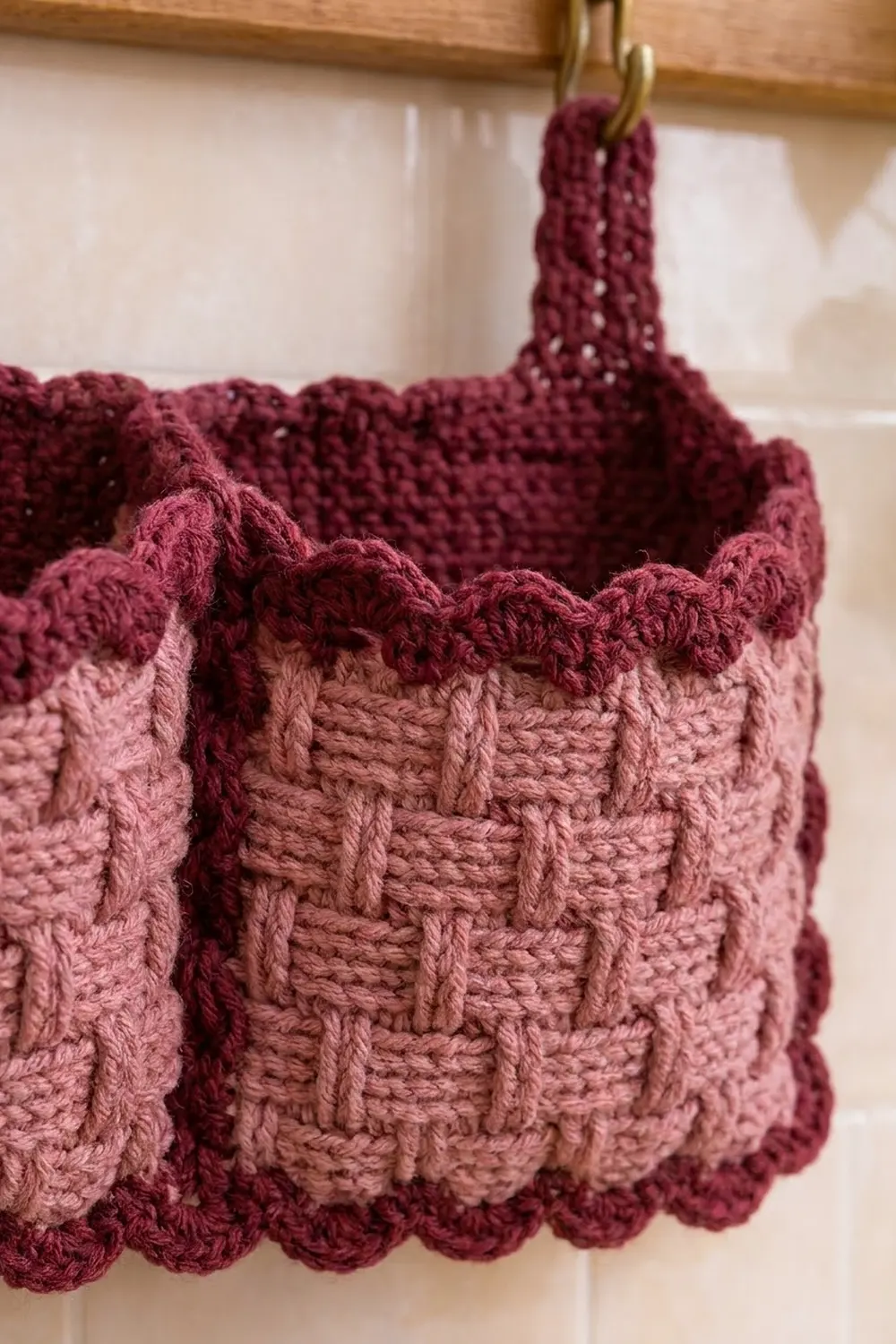
This hanging holder stores three spare toilet rolls in a neat row on the wall. Each pocket is a sturdy dusty rose basket with a deep, woven-looking texture. Burgundy shell scallops frame the top and bottom of every pocket, and a burgundy back panel with a corded edge ties the whole piece together.
The style is warm and a little rustic. It suits a bathroom with natural wood, brass hardware and plants. The two-tone palette makes the basketweave stand out, and the scallops soften the boxy shapes.
This pattern uses US crochet terms. The finished holder measures 16.4 in (41.7 cm) wide and 7.4 in (18.8 cm) tall across the bordered back panel. With the loops, the total height is 9.4 in (23.9 cm). Each pocket is 5 in (12.7 cm) wide, 4 in (10.2 cm) deep and about 5 in (12.7 cm) tall including the top scallops.
The construction is simple. You crochet three pockets from the base up in joined rounds, then add the scallop trims. Next you work a flat back panel in single crochet and give it a three-round border. Finally, you sew the pockets onto the panel stitch to stitch and add three folded hanging loops.
Finished Size and Construction
- Finished size: 16.4 x 7.4 in (41.7 x 18.8 cm) panel; 9.4 in (23.9 cm) tall with loops
- Skill level: Intermediate (post stitches, working in rounds, seaming)
- Terminology: US
- Yarn weight: Worsted (#4)
- Hook: 5.0 mm (H-8)
- Number of pieces: 7 (1 back panel, 3 pockets, 3 hanging loops)
- Layout: 3 pockets in a single row
- Pocket size: 5 in (12.7 cm) wide x 4 in (10.2 cm) deep x 5 in (12.7 cm) tall
- Panel size before border: 15 x 6 in (38.1 x 15.2 cm)
- Border depth: 0.7 in (1.8 cm) on each side
Materials
Use a firm worsted-weight cotton or cotton blend. Cotton holds the box shape well and stands up to bathroom humidity. Soft acrylic also works, but the pockets will be a little floppier. The amounts below assume a yarn with about 170 m per 100 g.
- Burgundy (Color A): 100 g / about 170 m (bases, trims, panel, border, loops)
- Dusty rose (Color B): 75 g / about 130 m (basketweave pocket walls)
- 5.0 mm (H-8) crochet hook
- Tapestry needle
- 8 locking stitch markers
- Scissors
- Measuring tape
- Pins and a blocking surface
Both quantities include a margin of about 25% for your swatch and for differences in tension.
Abbreviations (US Terms)
- ch – chain
- sl st – slip stitch
- sc – single crochet
- dc – double crochet
- BLO / FLO – back loop only / front loop only
- FPdc – front post double crochet
- BPdc – back post double crochet
- rev sc – reverse single crochet (crab stitch)
- sk – skip
- st(s) – stitch(es)
- RS – right side
Special stitch – Shell scallop: (sc in next st, sk 2 sts, 5 dc in next st, sk 2 sts). One scallop uses 6 sts.
Basketweave block: 4 post stitches of the same type (FPdc or BPdc) worked over 2 rounds. Switching the post type every 2 rounds makes the woven look.
Gauge and Checkpoints
Single crochet gauge: 16 sts and 18 rows = 4 in (10.2 cm) in sc worked in rows.
Basketweave gauge: 16 sts = 4 in (10.2 cm), and 8 rounds = 4 in (10.2 cm).
Make one complete pocket first and use it as your gauge test. A pocket gives you more reliable information than a flat swatch, because post-stitch fabric pulls in when it is worked in the round.
Check these measurements as you go:
- Base after Row 18: 5 x 4 in (12.7 x 10.2 cm)
- After Pocket Rnd 2: perimeter 18 in (45.7 cm)
- After Rnd 8: wall height 3.5 in (8.9 cm)
- After Rnd 10: wall height 4.5 in (11.4 cm)
- Panel after Row 9: height 2 in (5.1 cm)
- Panel after Row 27: 15 x 6 in (38.1 x 15.2 cm)
If your piece is too big by more than 0.25 in (0.6 cm), go down half a hook size. If it is too small, go up half a hook size. Don’t add or remove stitches. Every count in this pattern is linked to the others.
Pocket (Make 3)
Base
With Color A, ch 21.
Row 1: Sc in 2nd ch from hook and in each ch across. Turn. (20 sts)
Rows 2–18: Ch 1, sc in each st across. Turn. (20 sts)
The base should measure 5 x 4 in (12.7 x 10.2 cm).
Rnd 1 (edging): Ch 1, do not turn. Work 20 sc across the last row. Then work 16 sc evenly along the row ends, skipping the 6th and 13th row ends. Work 20 sc across the foundation chain, then 16 sc evenly along the other row-end edge in the same way. Join with sl st to first sc. (72 sts: 20 + 16 + 20 + 16)
Place a marker on the first st of each 20-st long side. One long side will be the pocket front and the other will be the back.
Walls
Change to Color B.
Rnd 2 (setup): Ch 2 (does not count as a st), dc in BLO of each st around. Join with sl st to first dc. (72 sts)
Working into the back loops makes the wall stand straight up. It also leaves the front loops of Rnd 1 free for the bottom scallop.
From here on, the ch 2 at the start of each round does not count as a stitch. Join every round with a sl st to the first st. Do not turn; keep the RS facing you.
Rnds 3–4: Ch 2, FPdc in next 4 sts, BPdc in next 4 sts; repeat from * 8 more times. (72 sts, 9 repeats)*
Rnds 5–6: Ch 2, BPdc in next 4 sts, FPdc in next 4 sts; repeat from * 8 more times. (72 sts)*
Rnds 7–8: Repeat Rnds 3–4. (72 sts)
Checkpoint: the wall is 3.5 in (8.9 cm) tall.
Rnds 9–10: Repeat Rnds 5–6. (72 sts)
Checkpoint: the wall is 4.5 in (11.4 cm) tall, with four bands of blocks.
Fasten off Color B.
Top Trim
Join Color A in any st at the center of the back wall, so the round join stays hidden against the panel.
Rnd 11: Ch 1, sc in each st around. Join. (72 sts)
Rnd 12: Ch 1, sc in next st, sk 2, 5 dc in next st, sk 2; repeat from * 11 more times. Join to first sc. (12 scallops: 12 sc + 60 dc = 72 sts)*
Fasten off.
Bottom Trim
Turn the pocket upside down. Join Color A in a free front loop of Rnd 1, near the center of the back long side.
