
If you’ve been looking for a crochet cardigan pattern, you’ve probably noticed how different they can be. Some are built from simple rectangles, others from granny squares, and some are worked in one piece from the neckline down. Each approach changes the difficulty, the yarn you need, and how the finished cardigan drapes.
This guide covers what to look for in a crochet cardigan pattern, which materials and stitches work best, and how a typical cardigan comes together, so you can choose a design with confidence.
What Makes a Crochet Cardigan Special
A cardigan is one of the most wearable things you can crochet. It layers over almost anything, works in every season with the right yarn, and forgives small sizing differences better than a fitted sweater.
Crochet also gives cardigans a look knitting doesn’t. The fabric is a little more structured, and stitch textures like shells, ribs, and squares stand out clearly. Many makers choose a crochet cardigan pattern because it’s mostly straight lines. Rectangles and simple shaping are easy to adjust as you go.
Materials You May Need
Exact requirements depend on the pattern and size you choose, so treat this as a starting list:
- Yarn: A smooth, medium-weight yarn (worsted or DK) is the easiest choice, and the stitches are easy to see. Cotton blends, wool blends, and soft acrylics are all common. Wearable garments need drape, so avoid stiff or scratchy fibers.
- Crochet hook: Follow the pattern’s recommendation, then adjust after swatching. Going up a hook size often gives a softer, more flowing fabric.
- Stitch markers: Handy for marking armholes, seams, and the start of rounds.
- Yarn needle: For joining pieces and weaving in ends.
- Measuring tape and scissors.
- Blocking supplies: Pins and a towel or blocking mats, if your yarn responds to blocking.
Yardage varies widely with size, yarn weight, and stitch pattern. Adult cardigans commonly take well over a thousand yards, and dense or textured stitches use more. Always follow the pattern’s yardage and buy an extra skein, since dye lots can vary.
Choosing and Making a Crochet Cardigan Pattern
Pick the construction method
The method you choose affects how the project feels while you work on it.
- Rectangles or panels: Two or three panels are seamed together, with sleeves added or worked separately. This is the most beginner-friendly route, since you’re mostly making rectangles.
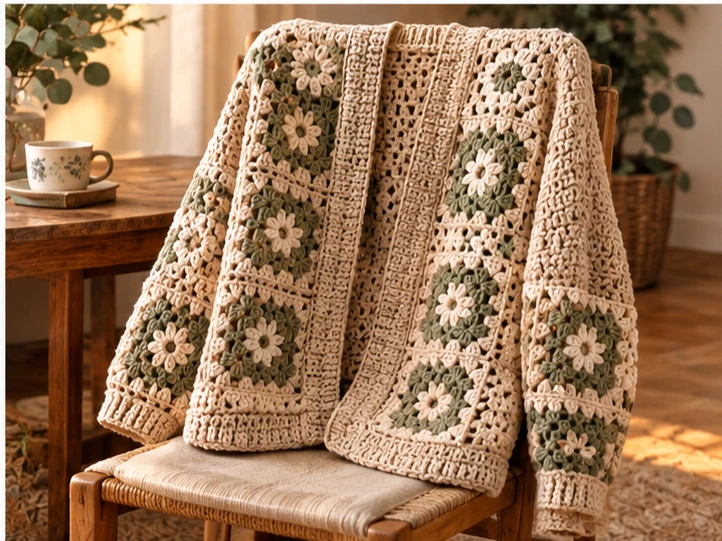
- Granny squares or motifs: Small, portable units you join together. It’s easy to work in pieces, but it involves more joining and finishing.
- One-piece or top-down: Worked from the neckline or in a single piece with shaping. Yes, a cardigan can be crocheted in one piece, though these patterns need more attention to stitch counts.
Make a gauge swatch
Don’t skip this. A swatch of about 5 to 6 inches lets you check that your stitches per inch match the pattern. If your swatch is too small, try a larger hook. If it’s too big, go down. A cardigan that’s off by a few stitches per inch can end up a full size too small or too large.
Work the body and sleeves
For a panel-style cardigan, you’ll typically:
- Make a foundation chain to the width of the back panel.
- Work in your chosen stitch pattern until the panel reaches the desired length.
- Make the front panels the same way, either as two narrower pieces or as one wide piece with a center opening.
- Crochet the sleeves as rectangles or tapered pieces.
Measure often against a cardigan you already own and like. Length, sleeve width, and depth of the armhole matter as much as the stitch counts.
Seam and finish
Lay the pieces flat and pin the shoulder seams first, then attach sleeves, then close the side seams. A crocheted seam with slip stitches is sturdy, while a whipstitch with a yarn needle is flatter and less bulky. Finish with a border or edging along the front opening and hem so the cardigan lies neatly.
Tips for a Better Result
Choose stitches with the right balance. Dense stitches like single crochet or moss stitch are warm but can feel heavy. Open or lacy stitches drape better and use less yarn but are cooler. Stitches with a knit-like look, such as the waistcoat stitch, tend to be the most compact and look the same on both sides. A simple half double crochet or double crochet fabric is a good middle ground for a first cardigan.
