
This hanging toilet paper holder keeps three spare rolls tidy. A sage-green triangular back panel hangs from a hook by a loop at its point. Three deep, round-bottomed pockets are sewn to the front: one near the top and two side by side below it, so the three rolls form a small pyramid.
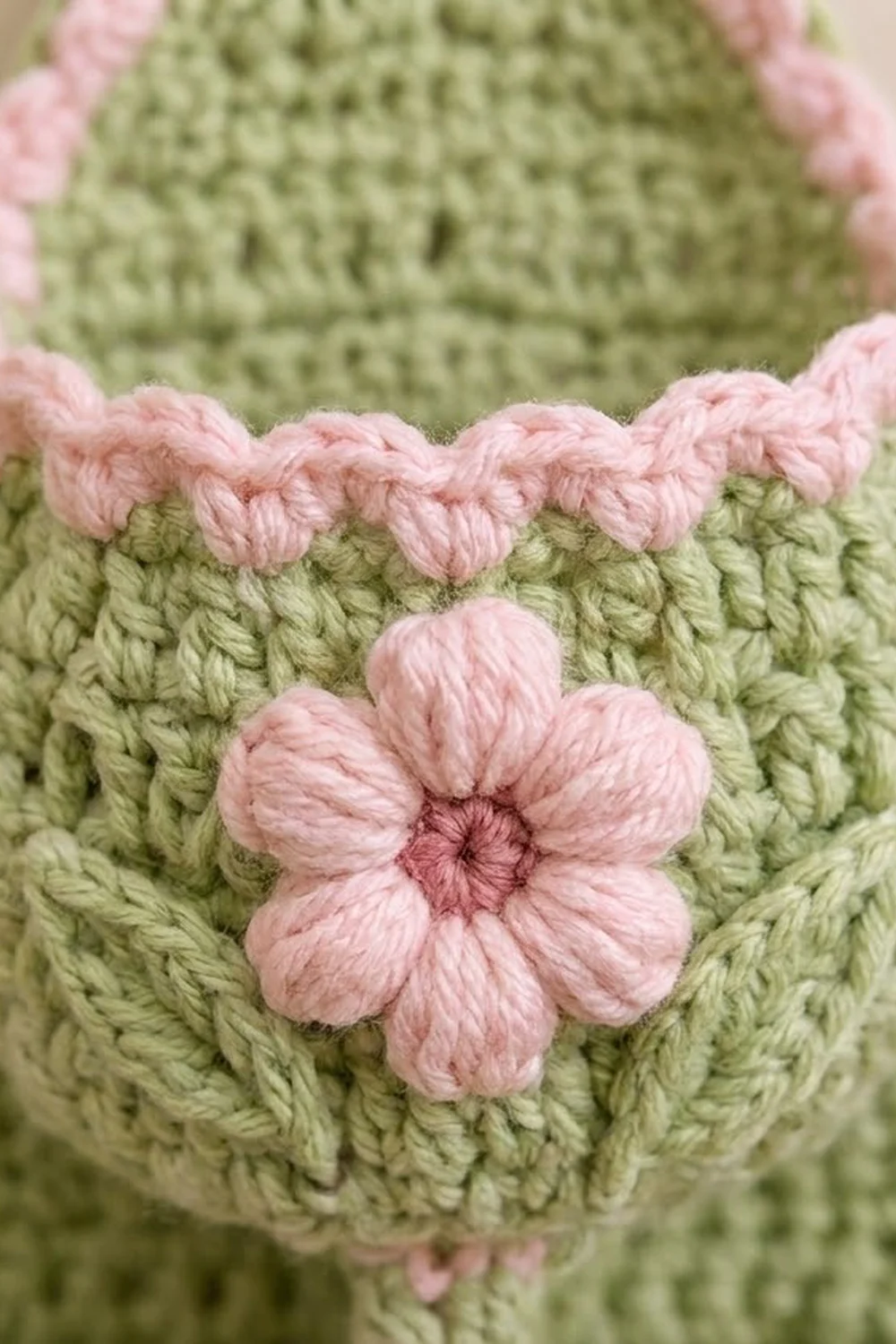
The palette is soft and cottage-style. The main fabric is sage green, the edges have light pink scalloped trim, and each pocket carries a puffy pink flower with a deeper rose center between two green leaves. The texture is dense double crochet, which is firm enough to hold its shape when filled.
The pattern uses US crochet terms. The finished back panel measures 13.0 in (33.0 cm) wide and 11.0 in (27.9 cm) tall, plus a 3.0 in (7.6 cm) hanging loop, for a total hanging length of 14.0 in (35.6 cm). Each pocket fits a standard roll up to about 4.5 in (11.4 cm) across and 4.25 in (10.8 cm) tall.
Construction is simple. You work the triangle top-down in rows, make three cup pockets in the round, add flowers and leaves, sew the pockets on, and finish with a pink border and the hanging loop.
Finished Size and Construction
- Finished size: 13.0 in (33.0 cm) wide × 11.0 in (27.9 cm) tall, plus a 3.0 in (7.6 cm) loop
- Skill level: Intermediate
- Terminology: US crochet terms
- Yarn weight: Worsted (#4)
- Hook: 5.0 mm (H-8)
- Number of pieces: 1 back panel, 3 pockets, 3 flowers, 6 leaves
- Layout: 1 pocket on top, 2 pockets below, arranged in a triangle
- Back panel before border: 12.0 in (30.5 cm) wide × 10.0 in (25.4 cm) tall
- Pocket size: 4.9 in (12.4 cm) base diameter, 3.75 in (9.5 cm) wall height including trim
- Border depth: 0.5 in (1.3 cm), 2 rounds
Materials
Use a smooth worsted cotton or a cotton blend. Cotton holds its shape, resists stretching under the weight of the rolls, and copes well with bathroom humidity. Acrylic also works, but the pockets may sag slightly over time.
- Sage green (MC): 150 g / 270 m, for the back panel, pockets, leaves and loop
- Light pink (CC1): 60 g / 110 m, for the borders, pocket trims and petals
- Rose pink (CC2): 10 g / 18 m, for the flower centers
All quantities include a margin of about 20%.
Tools:
– 5.0 mm (H-8) crochet hook
– Tapestry needle
– 6 locking stitch markers
– Scissors
– Measuring tape
– Blocking mat and pins
– Spray bottle
Abbreviations (US Terms)
- ch: chain
- sl st: slip stitch
- sc: single crochet
- hdc: half double crochet
- dc: double crochet
- BLO: back loop only
- st(s): stitch(es)
- rnd: round
- MR: magic ring
Puff st:(Yarn over, insert hook in the indicated st, yarn over, pull up a loop to 0.5 in height) 4 times. Yarn over and pull through all 9 loops on the hook.
Scallop: Sl st in the next st, then work (hdc, dc, hdc) in the following st. Each scallop uses 2 sts.
Gauge and Checkpoints
Gauge: 14 dc and 8 rows = 4 in (10.2 cm), and 14 sc = 4 in (10.2 cm). That works out to 3.5 sts and 2 dc rows per inch.
Make one pocket first. It is the best gauge test because it must fit a real roll.
Checkpoints:
– Pocket base after Rnd 5: 4.9 in (12.4 cm) across, with a circumference of about 15.4 in (39.1 cm).
– Back panel after Row 10: 22 sts measure 6.3 in (16.0 cm) wide, and the piece is 5.0 in (12.7 cm) tall.
– Back panel after Row 20: 42 sts measure 12.0 in (30.5 cm) wide, and the piece is 10.0 in (25.4 cm) tall.
If your pieces are too big, go down 0.5 mm in hook size. If they are too small, go up 0.5 mm. If the pocket base is right but the roll still fits tightly, add one extra wall round to keep the height. Don’t add base stitches.
Back Panel
With MC. The ch-2 at the start of each row does not count as a stitch.
Row 1: Ch 6. Dc in the 3rd ch from the hook and in each of the next 3 ch. Turn. (4 sts)
Row 2: Ch 2. 2 dc in the first st, dc in each st to the last st, 2 dc in the last st. Turn. (6 sts)
Rows 3–20: Repeat Row 2. Each row has 2 more sts than the row before, so Row n has 2n + 2 sts.
Key counts:
– Row 5: 12 sts
– Row 8: 18 sts
– Row 10: 22 sts
– Row 14: 30 sts
– Row 20: 42 sts
Do not fasten off at the end of Row 20. Leave a live loop on a marker for the border later.
Placement markers: Mark the first and last sts of Row 8 (top pocket line) and the first and last sts of Row 14 (lower pocket line). Then mark the center of Row 14, between sts 15 and 16.
Pockets (Make 3)
With MC, worked in continuous joined rounds. Join each rnd with a sl st to the first st, and ch 2 to start each rnd (the ch-2 does not count).
Base:
– Rnd 1: 12 dc in MR. (12 sts)
– Rnd 2: 2 dc in each st. (24 sts)
– Rnd 3: (Dc in next st, 2 dc in next st) 6 times. (36 sts)
– Rnd 4: (Dc in next 2 sts, 2 dc in next st) 12 times. (48 sts)
– Rnd 5: (Dc in next 7 sts, 2 dc in next st) 6 times. (54 sts)
Check: the base should be 4.9 in (12.4 cm) across and lie flat.
Wall:
– Rnd 6 (turning round): Ch 1, sc in BLO of each st. (54 sc + 0 added = 54 sts) The unworked front loops form a crisp base edge.
– Rnds 7–12: Dc in each st. (54 sts)
Fasten off MC. The wall measures 3.25 in (8.3 cm) at this point.
Trim:
– Rnd 13: Join CC1. Ch 1, sc in each st. (54 sc + 0 added = 54 sts)
– Rnd 14: Work 27 scallops around. Each scallop uses 2 sts, and 54 ÷ 2 = 27, so this round contains 27 sl sts and 27 three-stitch shells. Fasten off.
The finished wall height is 3.75 in (9.5 cm). A standard roll stands about 0.5 in (1.3 cm) above the trim.
