
Round 19 (scallop round):Ch 1, sc in first st, 14 times. Then skip 1 st, 5 dc in next st, skip last st, and join with sl st to first sc. (15 scallops and 15 sc)
Stitch check: 1 + (14 × 4) + 3 = 60. Fasten off and weave in the ends.
Back Panel (Make 1)
Work in rows with Color A.
Row 1: Ch 15, sc in 2nd ch from hook and in each ch across. (14 sts)
Rows 2–56: Ch 1, turn, sc in each st across. (14 sts)
Taper
Row 57: Ch 1, turn, sc2tog, sc in next 10 sts, sc2tog. (12 sts)
Row 58: Ch 1, turn, sc in each st across. (12 sts)
Row 59: Ch 1, turn, sc2tog, sc in next 8 sts, sc2tog. (10 sts)
Row 60: Ch 1, turn, sc in each st across. (10 sts)
Row 61: Ch 1, turn, sc2tog, sc in next 6 sts, sc2tog. (8 sts)
Row 62: Ch 1, turn, sc in each st across. (8 sts)
Row 63: Ch 1, turn, sc2tog, sc in next 4 sts, sc2tog. (6 sts)
Row 64: Ch 1, turn, sc in each st across. (6 sts)
The taper is 8 rows, about 2 in (5.1 cm).
Tab
Rows 65–76: Ch 1, turn, sc in each st across. (6 sts)
The tab is 12 rows, about 3 in (7.6 cm). The whole panel is 76 rows, about 19 in (48.3 cm) long. Do not fasten off.
Make All Pieces
- Pockets: 3, each in Color A (Rounds 1–17) and Color B (Rounds 18–19)
- Back panel: 1, in Color A only, with a Color A border
Layout, front view:
Border
The border is one round of sc in Color A around the whole panel, including the taper and the tab.
Border gauge: On the top and bottom edges, work 1 sc per stitch (14 sc per 4 in / 10.2 cm). On the sides, work 1 sc per row-end (16 sc per 4 in / 10.2 cm), which matches the row gauge.
In this section, the top and bottom counts include their 3-sc corner groups. The side counts don’t include corners.
Border Round: At the end of Row 76, ch 1 and turn.
- Top edge (tab end): 3 sc in first st, sc in next 4 sts, 3 sc in last st. (10 sc)
- First side: sc in each row-end from Row 75 down to Row 2. (74 sc)
- Bottom edge: 3 sc in first foundation ch, sc in next 12 ch, 3 sc in last ch. (18 sc)
- Second side: sc in each row-end from Row 2 up to Row 75. (74 sc)
- Join with sl st to first sc. (176 sc)
Why the math works: The top edge has 6 sts, so 3 + 4 + 3 = 10. The bottom edge has 14 foundation chains, so 3 + 12 + 3 = 18. Each side has 76 row-ends, but the corner groups already cover Rows 76 and 1, which leaves 74. That gives 10 + 74 + 18 + 74 = 176. The sides stay flat because each sc row is about as tall as one sc is wide.
The border adds about 0.25 in (0.6 cm) on every edge, so the panel now measures about 4.5 in (11.4 cm) by 19.5 in (49.5 cm). Fasten off and weave in the ends.
Joining
Attach the ring first. Pass the tab through the wooden ring from front to back. Fold it down so Row 76 lies against the back of Row 64. Whipstitch the tab stitches and their border stitches to the panel with Color A. The loop around the ring is about 1.5 in (3.8 cm).
Mark each pocket. On Round 17, mark the 14 sts centered on the back join: sts 54–60 and sts 1–7. Mark the same 14 sts on Round 11. At 14 sts per 4 in, these 14 sts span 4 in (10.2 cm), the same as the panel width before the border.
Placement:
- Pocket 1: Round 11 on Row 2, Round 17 on Row 14
- Pocket 2: Round 11 on Row 22, Round 17 on Row 34
- Pocket 3: Round 11 on Row 42, Round 17 on Row 54
Each pocket starts 20 rows above the one below it, which is 5 in (12.7 cm). That space holds 3 in (7.6 cm) of sewn wall, about 1 in (2.5 cm) of free rim and a 1 in (2.5 cm) gap.
Sewing stitch to stitch: Whipstitch the 14 marked sts of Round 17 to the 14 sts of the matching panel row, one stitch to one stitch. Do the same for Round 11. Then sew the two side lines: the column above st 54 to panel st 1, and the column above st 7 to panel st 14.
Tension: Pull each stitch snug but not tight. The panel should stay flat, and the back of the pocket should not pucker. Leave the cream rim unsewn so the scallops stand up.
Size checkpoint: The assembled holder hangs about 17 in (43.2 cm) from the bottom border to the top of the tab loop.
Final Blocking
- Lightly mist the holder with water, or hold a steam iron 1 in (2.5 cm) above it without touching the yarn.
- Slide a roll or can, wrapped in a plastic bag, into each pocket.
- Shape each base so it is round and flat, and ease each wall to 4 in (10.2 cm) tall.
- Open each leaf sprig with your fingers so the gaps are even.
- Pin the 15 scallops so they curve evenly outward.
- Pin the panel edges straight at 4.5 in (11.4 cm) wide.
- Let it dry completely, then remove the forms and pins.
Final Quality-Control Checklist
- Each base has 60 sts and lies flat at about 5.25 in (13.3 cm).
- Each pocket has 10 leaf sprigs and 15 cream scallops.
- All three pockets are 4 in (10.2 cm) tall.
- The panel border has 176 sc, and the panel is 4.5 in (11.4 cm) wide.
- The round joins are hidden against the panel.
- The tab is sewn securely and the ring turns freely.
- All ends are woven in.
Troubleshooting
- Base cups or ruffles: Recount each round and change hook size if needed.
- Leaves look flat: Keep the loops even and don’t tighten the final pull-through.
- Lace band pulls in: Chain the ch-3 spaces more loosely.
- Round 17 count is wrong: Skip the ch-1 spaces and work once in each ch-2 space.
- Scallops ruffle: Use a smaller hook for Round 19 only.
- Panel edges wave: Recount the border to 74 sc per side.
- Pocket tips forward: Sew another line along Round 14 behind the V-stitches.
Care
Hand wash in cool water with mild soap, then roll the holder in a towel to remove water. Dry it flat with a roll inside each pocket, and don’t tumble dry.
Final Notes
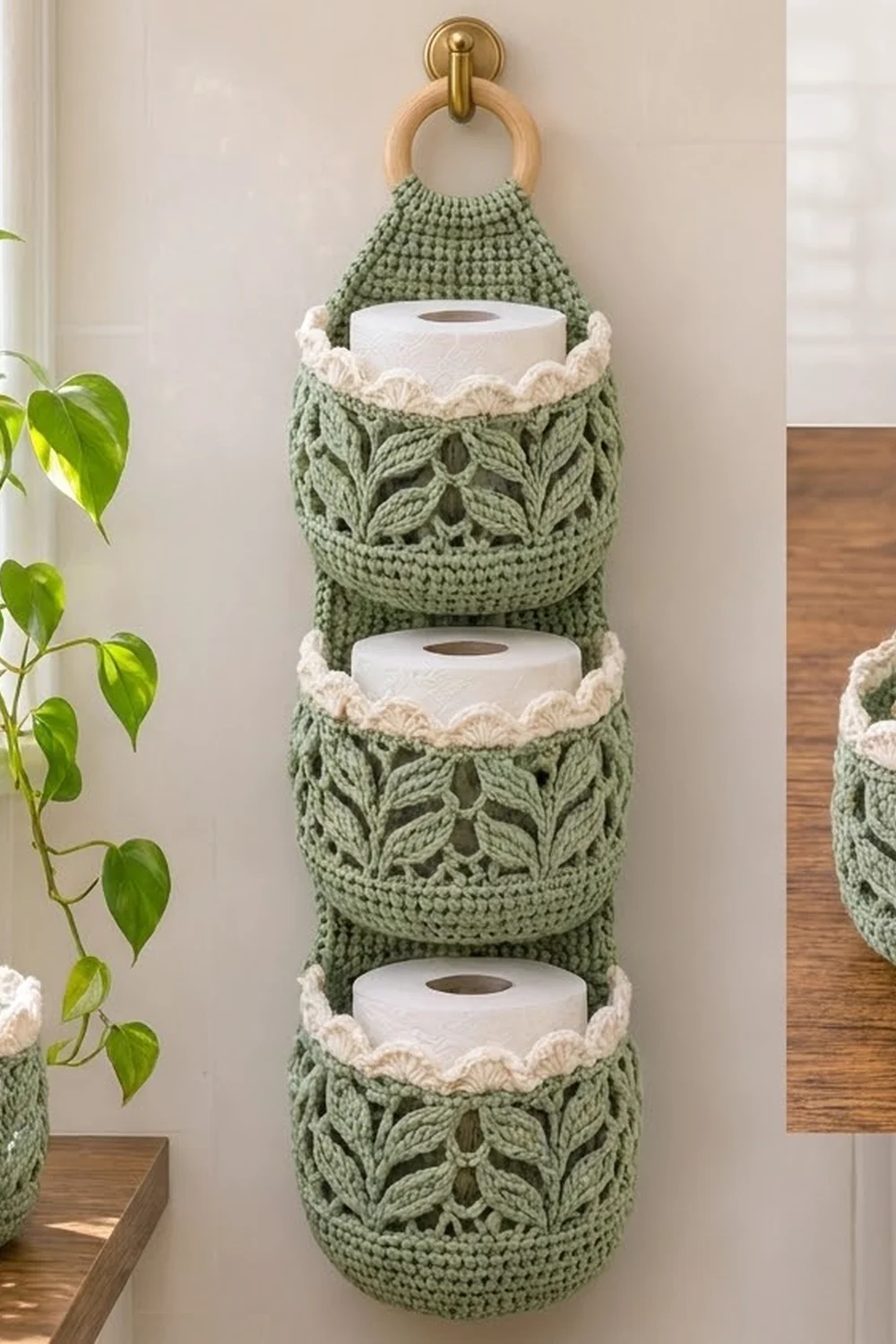
Each measurement depends on the one before it. A gauge of 14 sc per 4 in (10.2 cm) gives a 60-stitch base of 5.25 in (13.3 cm). Ten 6-stitch lace repeats return to 60 stitches, and 15 scallops finish a pocket 4 in (10.2 cm) tall. The 14-stitch panel matches the 14 back stitches of each pocket. The border brings the panel to 4.5 in (11.4 cm), and three pockets spaced every 5 in (12.7 cm) make a holder about 17 in (43.2 cm) long.
Happy crocheting!
