
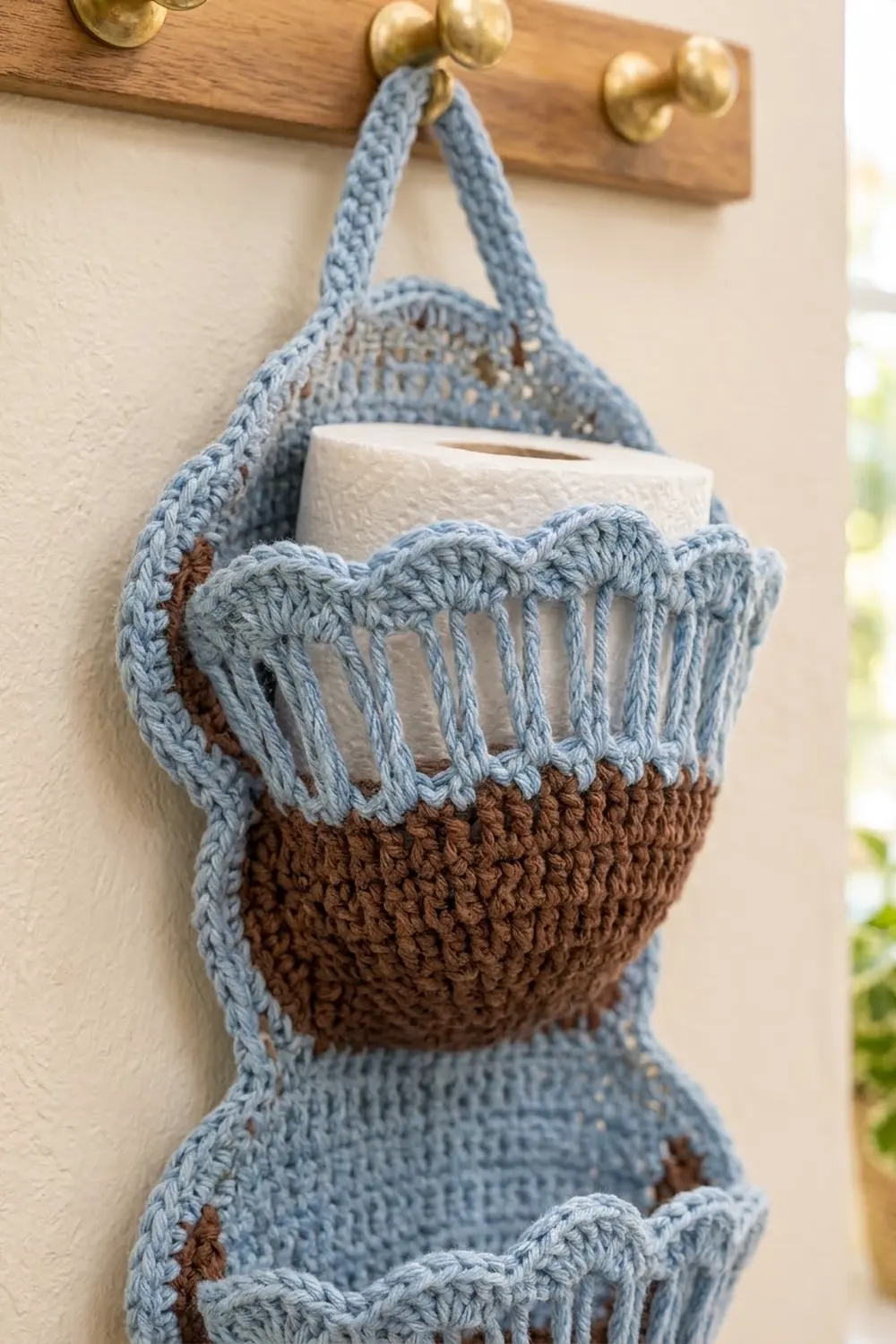
This hanging holder stores three toilet rolls in one narrow column on the wall. A soft blue backing panel with three rounded lobes carries three brown pockets. Each pocket has a bowl-shaped base and an airy blue crown of tall stitches with a scalloped rim.
The colors are a light sky blue and a warm chocolate brown. Together they look cottage-style and calm, and they suit a bathroom with plants, wood and brass. The panel edge is finished with reverse single crochet, which gives a neat corded outline.
The pattern uses US crochet terms. The finished holder is 6.8 in (17.3 cm) wide and 16.8 in (42.7 cm) tall, not counting the strap loop. The loop adds about 3 in (7.6 cm) above the panel.
How it is built: you crochet the backing panel in shaped single crochet rows. Then you make three pockets in the round, starting at the base, and one strap. You sew the pockets to the panel, add a two-round border around the panel, and sew on the strap.
Finished Size and Construction
- Finished size: 6.8 in x 16.8 in (17.3 cm x 42.7 cm), plus a strap loop of about 3 in (7.6 cm)
- Skill level: Intermediate
- Terminology: US
- Yarn weight: Worsted (#4), cotton or cotton blend
- Hook: 5 mm (H-8)
- Number of pieces: 5 (1 panel, 3 pockets, 1 strap)
- Layout: 1 column with 3 pockets stacked
- Panel size before border: 6 in (15.2 cm) wide at the lobes, 5 in (12.7 cm) at the waists, 16 in (40.6 cm) tall
- Pocket size: base 4.75 in (12.1 cm) across; about 3.5 in (8.9 cm) tall
- Border depth: about 0.4 in (1.0 cm)
Materials
Use cotton or a cotton blend. Cotton keeps its shape, holds the weight of the rolls and washes well. Acrylic will also work, but the pockets will stretch more.
- Color A, light blue: 140 g / 265 m
- Color B, chocolate brown: 100 g / 190 m
These amounts include a margin of about 20% for your gauge swatch and tails.
Tools:
– 5 mm (H-8) crochet hook
– Tapestry needle
– 6 stitch markers
– Scissors
– Measuring tape
– Blocking mat and rustproof pins
– Spray bottle
Abbreviations (US Terms)
- ch – chain
- sl st – slip stitch
- sc – single crochet
- dc – double crochet
- dtr – double treble crochet
- sc2tog – single crochet 2 together
- inc – 2 sc in the same stitch
- BLO – back loop only
- MR – magic ring
- rev sc – reverse single crochet
- st(s) – stitch(es)
- sp – space
Special stitches
Double treble (dtr): Yarn over 3 times. Insert the hook in the stitch, yarn over and pull up a loop (5 loops on hook). Yarn over and pull through 2 loops. Repeat from * 3 more times.
Reverse single crochet (rev sc): Work from left to right (right-handed). Insert the hook in the next stitch to the right, pull up a loop, then yarn over and pull through both loops.
Gauge and Checkpoints
Gauge: 16 sc x 18 rows = 4 in (10.2 cm), using the 5 mm hook.
Make one pocket first. It is quick to make and checks both your sc gauge and your dtr height.
Checkpoints:
– Pocket Rnd 10: the flat base measures 4.75 in (12.1 cm) across.
– Pocket Rnd 18: the dtr round is about 1.25 in (3.2 cm) tall.
– Panel Row 5: the panel is 6 in (15.2 cm) wide.
– Panel Row 24: the panel is 5.33 in (13.5 cm) tall.
– Panel Row 48: the panel is 10.67 in (27.1 cm) tall.
– Panel Row 72: the panel is 16 in (40.6 cm) tall.
If your work is too big, change to a hook 0.5 mm smaller. If it is too small, change to a hook 0.5 mm larger. A standard toilet roll is about 4.5 in (11.4 cm) across, so the pocket base must not end up smaller than that.
Backing Panel (make 1)
Use color A. You work the panel in rows from the bottom to the top. At the start of each row, ch 1 and turn; this ch 1 does not count as a stitch.
- Inc row: 2 sc in the first st, sc to the last st, 2 sc in the last st.
- Dec row: sc2tog, sc to the last 2 sts, sc2tog.
Lobe 1 (bottom)
Row 1: Ch 17, sc in the 2nd ch from the hook and in each ch across. (16 sts)
Rows 2–5: Work an inc row. (Row 2: 18 sts; Row 3: 20; Row 4: 22; Row 5: 24)
Rows 6–20: Sc in each st across. (24 sts)
Rows 21–22: Work a dec row. (Row 21: 22 sts; Row 22: 20)
Rows 23–24: Sc in each st across. (20 sts)
Checkpoint: 5.33 in (13.5 cm) tall.
Lobe 2 (middle)
Rows 25–26: Work an inc row. (Row 25: 22 sts; Row 26: 24)
Rows 27–44: Sc in each st across. (24 sts)
Rows 45–46: Work a dec row. (Row 45: 22 sts; Row 46: 20)
Rows 47–48: Sc in each st across. (20 sts)
Checkpoint: 10.67 in (27.1 cm) tall.
Lobe 3 (top)
Rows 49–50: Work an inc row. (Row 49: 22 sts; Row 50: 24)
Rows 51–68: Sc in each st across. (24 sts)
Rows 69–72: Work a dec row. (Row 69: 22 sts; Row 70: 20; Row 71: 18; Row 72: 16)
Fasten off. Each lobe is 24 rows, so the panel totals 72 rows, which is 16 in (40.6 cm) at 18 rows per 4 in.
Mark the pocket lines. Place a pair of markers in each row listed below, one at each end of the center 20 sts:
- Bottom pocket: Rows 4 and 18
- Middle pocket: Rows 28 and 42
- Top pocket: Rows 52 and 66
Pocket (make 3)
You work each pocket in continuous rounds. Do not join the rounds, and move a marker up to the first stitch of every round.
Base (color B)
Rnd 1: 6 sc in the MR. (6)
Rnd 2: Inc in each st around. (12)
Rnd 3: Sc 1, inc 6 times. (18)
Rnd 4: Sc 2, inc 6 times. (24)
Rnd 5: Sc 3, inc 6 times. (30)
Rnd 6: Sc 4, inc 6 times. (36)
Rnd 7: Sc 5, inc 6 times. (42)
Rnd 8: Sc 6, inc 6 times. (48)
Rnd 9: Sc 7, inc 6 times. (54)
Rnd 10: Sc 8, inc 6 times. (60)
Checkpoint: the base is flat and 4.75 in (12.1 cm) across.
Sides (color B)
Rnd 11: Sc in the BLO of each st around. (60) This makes a clean fold line, and the unused front loops of Rnd 10 become your sewing line later.
Rnds 12–16: Sc in each st around. (60)
Checkpoint: the brown sides measure about 1.33 in (3.4 cm) tall. Change to color A in the last st of Rnd 16 and fasten off B.
