
Join CC in the next unworked st of Rnd 19 and repeat Rows 1–6. Make 6 petals in total, using up all 60 sts with no gaps (6 x 10 = 60).
Petal edging: Join CC at the base of any petal. Sc in each of the 6 row ends up the right side, (sc, ch 1, sc) in the tip, sc in each of the 6 row ends down the left side, sl st in the valley between petals around, join. (14 sc + 1 ch-1 sp per petal; 84 sc, 6 ch-1 sps and 6 sl sts total)
The outline gives each petal a slightly raised edge and a sharp tip. Fasten off and weave in ends.
Checkpoint: the yellow rim is 2 in (5.1 cm) tall, and the finished pocket is 5.75 in (14.6 cm) tall.
Hanging Tab (make 2)
With MC, ch 9.
Row 1: Sc in 2nd ch from hook and in each ch across, turn. (8 sts)
Rows 2–24: Ch 1, sc in each st across, turn. (8 sts)
The tab measures 2.1 in (5.3 cm) x 6 in (15.2 cm). Fasten off and leave a 12 in (30.5 cm) tail for sewing.
Make All Pieces
- Sage green (MC): 1 back panel, 3 pocket bodies, 2 tabs
- Butter yellow (CC): 3 petal rims (Rnd 19, 6 petals and edging on each pocket)
Layout, seen from the front (columns are panel stitches):
Joining
Pockets: Lay the panel flat with the right side facing you. On each pocket, place 2 markers on Rnd 11, 20 sts apart. These 20 sts are the back of the pocket, the side that lies against the wall. Arrange each pocket so that one V column sits right at each marker.
Using MC and a yarn needle, whipstitch the 20 marked Rnd 11 sts to the 20 panel sts in Row 2 of that pocket’s columns, one stitch to one stitch. Pocket 1 goes on sts 1–20, Pocket 2 on sts 21–40 and Pocket 3 on sts 41–60. Together they cover all 60 sts (3 x 20 = 60).
Next, sew straight up each side of the back. Each V round is 0.5 in (1.3 cm) tall, which equals 2 panel rows. Take one stitch per panel row, so that Rnds 12–18 (7 rounds) sit over panel Rows 3–16 (14 rows, 3.5 in / 8.9 cm). Leave the yellow petals free.
The middle pocket shares column lines with its neighbors. Catch both pocket edges in the same seam at sts 20/21 and 40/41.
Tension: Make the whipstitches snug but not tight. Pulling too hard will gather the panel. Every 2 in (5.1 cm) or so, lay the work flat to check that the panel stays 16 in (40.6 cm) wide.
Tabs: Fold each tab in half to make a 3 in (7.6 cm) loop. Place both ends on the back of the panel, one on top of the other, over sts 5–12 (left) or sts 49–56 (right). Let them overlap the panel by 1 in (2.5 cm), which covers Rows 23–26. Sew around the overlap twice for strength. Each loop should stand 2 in (5.1 cm) above the top edge.
Size checkpoint: before the border, the panel is still 16 in (40.6 cm) x 6.5 in (16.5 cm). The petal tips sit about 0.5 in (1.3 cm) below the top edge.
Border
Border gauge: the border uses the same sc gauge, 15 sts per 4 in (10.2 cm). One round is 0.25 in (0.6 cm) deep.
Only the panel gets a border. The pockets and tabs are sewn on top of it, so they add no stitches to the edge. The top edge’s starting count is therefore 1 panel x 60 sts = 60 sts.
Rnd 1: With the right side facing, join MC in the last st of Row 26.
- Top: 3 sc in the first st (corner), sc in each of the next 58 sts, 3 sc in the last st (corner).
- Left side: sc in each row end of Rows 25 down to 2. (24 sc)
- Bottom: working into the foundation chain, 3 sc in the first ch (corner), sc in each of the next 58 ch, 3 sc in the last ch (corner).
- Right side: sc in each row end of Rows 2 up to 25. (24 sc)
- Join to the first sc.
Counts per side (including both corner center stitches): top and bottom have 1 + 1 + 58 + 1 + 1 = 62 sts each. Left and right have 1 + 1 + 24 + 1 + 1 = 28 sts each. Total: (2 x 62) + (2 x 28) − 4 shared corner sts = 176 sts. As a check: 4 corners x 3 = 12, plus 2 x 58 = 116, plus 2 x 24 = 48, which also makes 176.
Why the math works: the panel was 16 in (40.6 cm) wide, and the border adds 0.25 in (0.6 cm) on each side to make 16.5 in (41.9 cm). The sides work the same way: 6.5 in (16.5 cm) plus 0.25 in (0.6 cm) at the top and bottom gives 7 in (17.8 cm). On the sides, one sc per row end lies flat because sc rows (4 per inch) and sc stitches (3.75 per inch) are almost the same size.
Fasten off and weave in all ends.
Final Blocking
- Lightly mist the whole holder with water, or steam it gently if you used acrylic, holding the iron above the yarn.
- Pin the panel flat on a blocking mat to 16.5 in (41.9 cm) x 7 in (17.8 cm).
- Pin the 4 corners into soft curves to give the rounded look.
- Stuff each pocket with a toilet roll wrapped in a plastic bag so the cups dry round.
- Pin each petal tip outward so the points stay sharp.
- Smooth the hanging loops flat.
- Let everything dry completely before you unpin it.
Final Quality-Control Checklist
- The panel measures 16.5 in (41.9 cm) x 7 in (17.8 cm).
- Each pocket base is 5 in (12.7 cm) across and lies flat.
- Each pocket has 30 V columns, 60 rim sts and 6 even petals.
- The pocket backs line up with panel sts 1–20, 21–40 and 41–60.
- The loops stand 2 in (5.1 cm) above the top and match in height.
- The border has 176 sts, and the corners lie flat.
- No yarn ends show on the front.
- The holder hangs level with three rolls in it.
Troubleshooting
- Pocket base is cupping: your stitches are too tight for 6 increases per round. Use a larger hook on the base only.
- Pocket base ruffles: your stitches are too loose. Use a smaller hook on the base.
- Roll doesn’t fit: check Rnd 10. If it is under 5 in (12.7 cm), redo the base with a larger hook.
- V columns twist: make sure each V goes into the ch-1 sp of the V directly below it, not into the gap between Vs.
- Petals curl: block them pinned flat. If they still curl, work the petal edging a little looser.
- Panel gathers at the seams: loosen your whipstitch and take only one stitch per panel row.
- Holder sags in the middle: add a third short tab at the center, sts 27–34.
Care
Hand wash in cool water with mild soap, press out the water in a towel, and dry flat with a roll in each pocket to keep the shape.
Final Notes
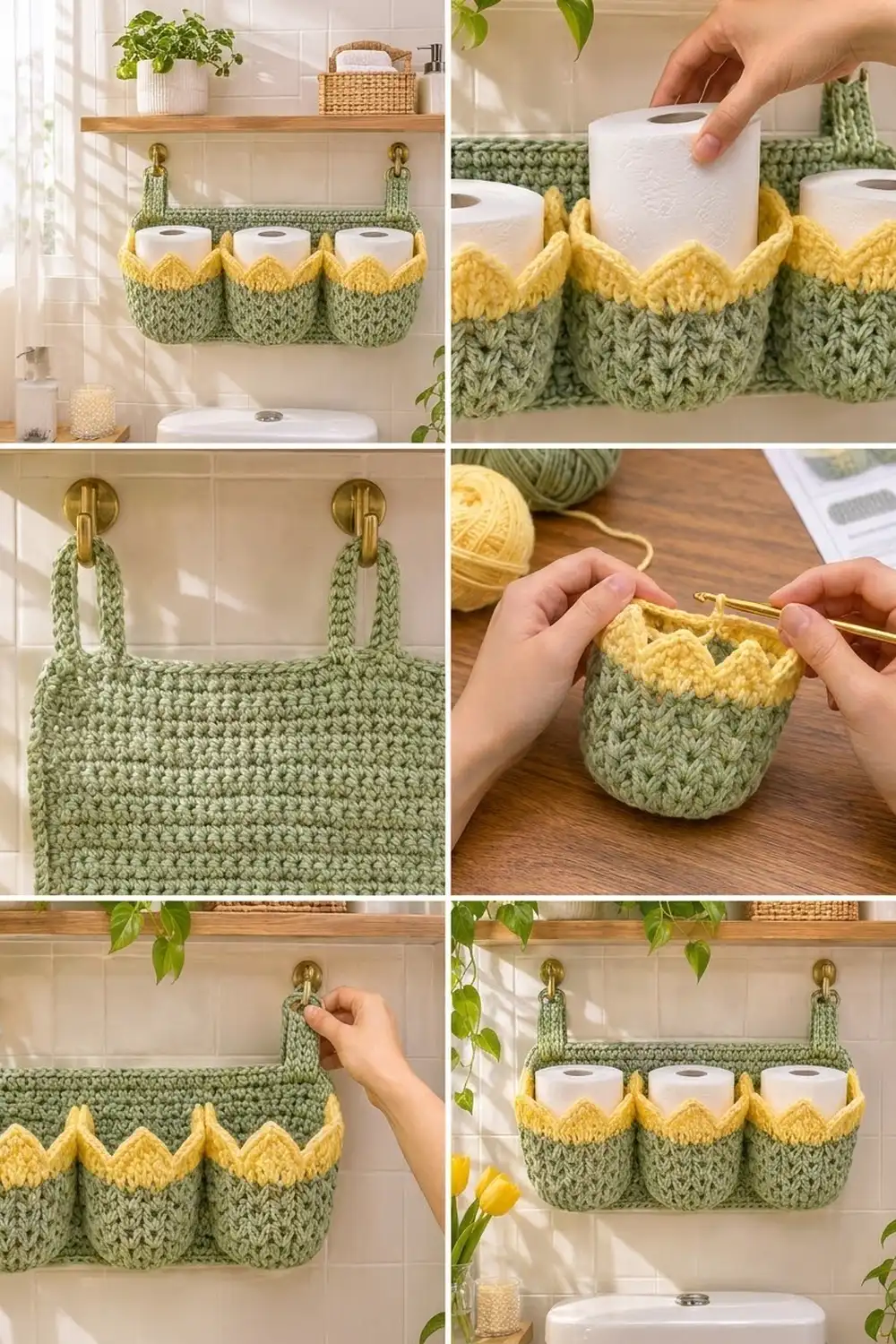
Everything in this holder follows from one gauge, 15 sc per 4 in (10.2 cm). The 60-stitch pocket base is 5 in (12.7 cm) across. Each pocket’s 20-stitch back lines up with 20 panel stitches, so three pockets fill the 60-stitch, 16 in (40.6 cm) panel. One border round brings the panel to 16.5 in (41.9 cm) x 7 in (17.8 cm), and the loops make the total height 9 in (22.9 cm). If your first pocket hits its checkpoints, the rest will follow.
Happy crocheting!
