
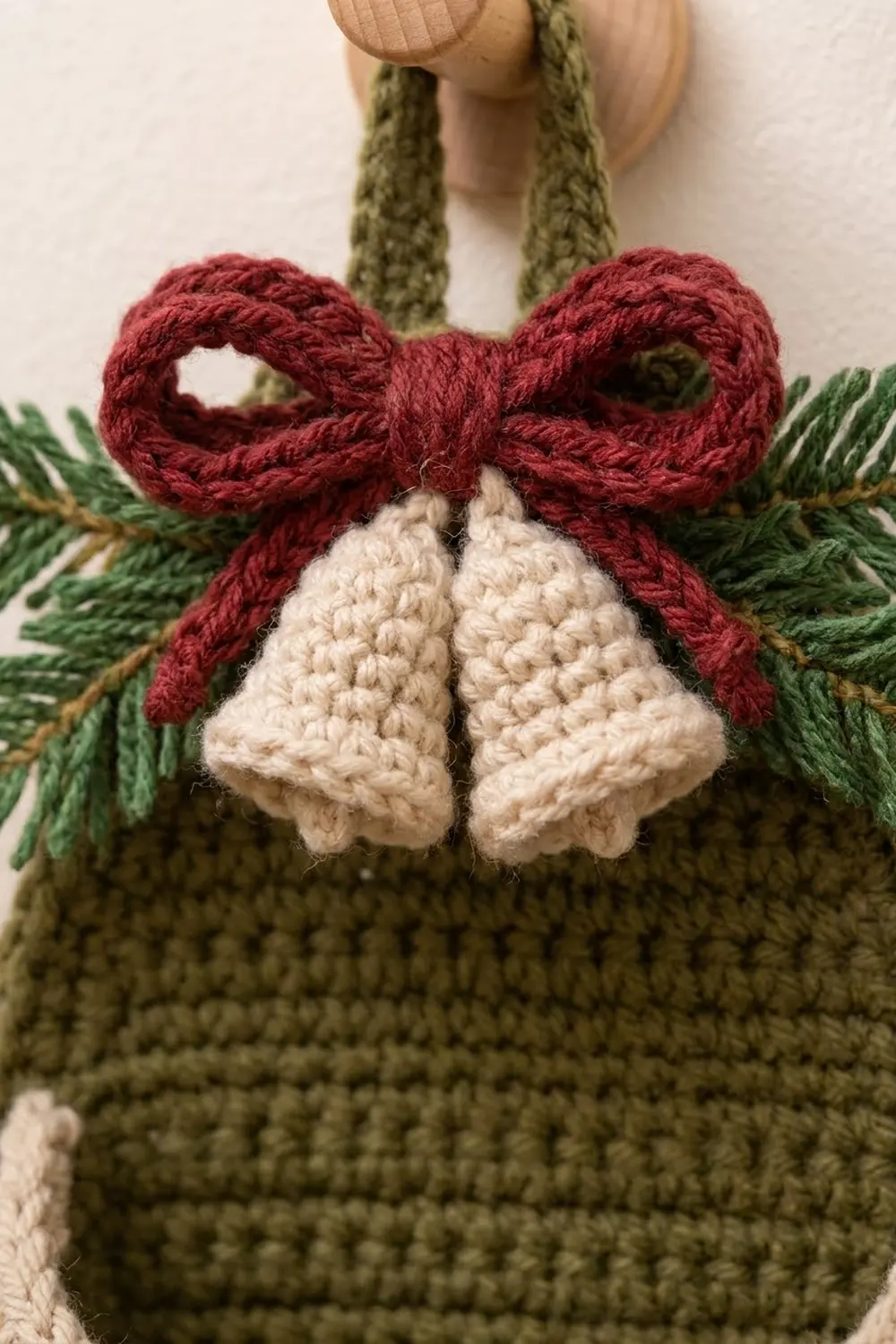
This hanging toilet paper holder stores three rolls in a slim column. A long olive green backing panel with rounded ends carries three deep, bowl-shaped pockets covered in crocodile-stitch scales. Each pocket ends in a row of cream scales and a cream rim, and the top of the panel has a small cranberry bow, two cream bells, and pine sprigs.
The colors are soft and seasonal: olive green, warm cream, cranberry red, and deep pine green. The style is cozy farmhouse, and it suits a bathroom all winter, not only at Christmas.
The pattern uses US crochet terms. The finished panel measures 6.5 in (16.5 cm) wide and 24.5 in (62.2 cm) tall. Each pocket is 4.75 in (12.1 cm) across and 3.5 in (8.9 cm) deep, which holds a standard 4.25 in (10.8 cm) roll.
To build it, you work the panel as an oval in single crochet rounds. You crochet each pocket from the base up as a cup with crocodile-stitch sides. Then you sew the pockets to the panel, work a two-round border with a built-in hanging loop, and add the small decorations at the top.
Finished Size and Construction
- Finished panel size: 6.5 in x 24.5 in (16.5 cm x 62.2 cm)
- Width at sprigs: about 9 in (22.9 cm)
- Skill level: Intermediate (crocodile stitch)
- Terminology: US
- Yarn weight: Worsted (#4)
- Hook: 5.0 mm (H-8)
- Number of pieces: 11 (1 panel, 3 pockets, 1 bow, 2 bells, 4 sprigs)
- Layout: 1 column of 3 pockets stacked on a single panel
- Pocket size: 4.75 in (12.1 cm) diameter x 3.5 in (8.9 cm) deep
- Panel size before border: 6 in x 24 in (15.2 cm x 61.0 cm)
- Border depth: 0.25 in (0.6 cm) per edge
Materials
Choose a smooth worsted yarn. Acrylic or an acrylic-wool blend holds the scale shapes well and can handle a humid bathroom. Pure cotton also works, but it is heavier and may make the panel sag a little.
- Olive green (Color A): 250 g / 500 m
- Cream (Color B): 80 g / 160 m
- Cranberry red (Color C): 10 g / 20 m
- Pine green (Color D): 10 g / 20 m
All quantities include a margin of about 15 percent. Crocodile stitch uses a lot of yarn, so don’t cut it close.
Tools:
- 5.0 mm (H-8) crochet hook
- Yarn needle
- 6 stitch markers
- Rust-proof pins
- Measuring tape
- Wall peg or hook for hanging
Abbreviations (US Terms)
- ch – chain
- sl st – slip stitch
- sc – single crochet
- dc – double crochet
- st(s) – stitch(es)
- sp – space
- sk – skip
- BLO – back loop only
- MR – magic ring
- beg – beginning
- rnd(s) – round(s)
- rep – repeat
Pair: 2 dc worked in the same stitch or space. In this pattern a beginning ch 3 plus 1 dc also counts as a pair.
Scale: Rotate the work so the pair hangs sideways. Work 5 dc around the post of the first dc of the pair, going from top to bottom. Ch 1, then work 5 dc around the post of the second dc, going from bottom to top. One scale has 10 dc and covers the pair below it like a shingle.
Gauge and Checkpoints
Gauge: 16 sc and 17 rnds = 4 in (10.2 cm) in sc worked in rounds.
Before you start the panel, make one complete pocket. It is the most technical piece, and it tells you right away whether a roll will fit.
Checkpoints:
- Panel after Rnd 1: 18.5 in (47.0 cm) long
- Panel after Rnd 7: 3.3 in (8.4 cm) wide
- Panel after Rnd 13: 6 in x 24 in (15.2 cm x 61.0 cm)
- Pocket base after Rnd 10: 4.75 in (12.1 cm) across
- First posts round of a pocket: 15 in (38.1 cm) around
- Finished pocket: 3.5 in (8.9 cm) deep, with an inside opening of at least 14.5 in (36.8 cm) around
If your pieces come out too big, go down half a hook size. If they are too small, go up half a size. If a roll will not slide into a test pocket easily, go up a hook size for the pocket only. The pocket must hold its round shape over a 4.25 in (10.8 cm) roll.
Backing Panel
Use Color A. You work the panel in joined rounds around both sides of a foundation chain. Each round starts at the first stitch of End A, which becomes the top of the panel. The two straight sides keep 70 sts each in every round. Only the ends grow, by 3 sts per end each round.
Foundation: Ch 73.
Rnd 1: 3 sc in 2nd ch from hook (End A), sc in next 70 ch (Side 1), 3 sc in last ch (End B). Rotate the work and sc in the unused loop of the next 70 ch (Side 2). Join with a sl st to the first sc. (146 sts: 3 + 70 + 3 + 70)
Rnd 2:Ch 1 (does not count as a st here or in later rounds). 3 times, sc in next 70 sts, 3 times, sc in next 70 sts. Join. (152 sts: 6 per end, 70 per side)
Rnd 3:Ch 1. 3 times, sc in next 70 sts, 3 times, sc in next 70 sts. Join. (158 sts: 9 per end)
Rnds 4–13:Ch 1. For each end, work 3 times, where n is the round number. Work sc in each of the 70 side sts. Join.
Stitch counts:
- Rnd 4: 164 (12 per end)
- Rnd 5: 170 (15 per end)
- Rnd 6: 176 (18 per end)
- Rnd 7: 182 (21 per end)
- Rnd 8: 188 (24 per end)
- Rnd 9: 194 (27 per end)
- Rnd 10: 200 (30 per end)
- Rnd 11: 206 (33 per end)
- Rnd 12: 212 (36 per end)
- Rnd 13: 218 (39 per end)
As a check, Rnd 13 equals 70 + 39 + 70 + 39 = 218. Don’t fasten off. Set the panel aside with a live loop on a marker.
Pocket (Make 3)
Base (Color A):
Rnd 1: 6 sc in MR. Join with a sl st to the first sc. (6)
Rnds 2–10:Ch 1. 6 times, where n is the round number. Join. Each round has 6n sts, so the base ends with 60 sts in Rnd 10.
Rnd 11: Ch 1, sc in BLO of each st around. Join. (60) This turning ridge makes the sides stand up.
Scale section:
Rnd 12 (posts): Ch 3 (counts as dc), dc in the same st, ch 1, sk 2 sts. *2 dc in next st, ch 1, sk 2 sts; rep from * around. Join to the top of the beg ch 3. (20 pairs + 20 ch-1 sps = 60 sts)
Rnd 13 (scales): Make a scale over the first pair. *Sk ch-1 sp, sl st between the 2 dc of the next pair, sk ch-1 sp, scale over the next pair; rep from * 8 more times. Sk ch-1 sp, sl st between the dc of the last pair. Join with a sl st to the top of the first scale. (10 scales, 10 skipped pairs)
Rnd 14 (posts): Sl st into the center top of the first scale. Ch 3, dc in the same sp, ch 1. 2 dc in the sl st at the center of the next skipped pair, ch 1. *2 dc in the center top of the next scale, ch 1, 2 dc in the center of the next skipped pair, ch 1; rep from * 8 more times. Join. (20 pairs + 20 ch-1 sps = 60 sts)
Rnd 15 (scales): Sl st in the next dc and the next ch-1 sp. *Scale over the next pair, sk ch-1 sp, sl st in the center of the next pair, sk ch-1 sp; rep from * 9 more times. Join. (10 scales) These scales sit between the scales of Rnd 13.
Rnds 16–17: Rep Rnds 14–15. (60 sts; 10 scales)
Rnd 18: Rep Rnd 14. (60 sts) Fasten off Color A.
Rnd 19 (Color B): Join Color B and rep Rnd 15. (10 cream scales)
Rim (Color B):
