
This hanging holder keeps three spare toilet rolls in a neat vertical column. Each round pocket has a solid single crochet base, a band of openwork leaf sprigs and a cream scalloped rim. A long back panel holds the pockets together and loops over a wooden ring at the top.
The colors are soft and botanical: sage green for the pockets and panel, and cream for the rim band and shell scallops. The lace band is the main feature. Raised leaf clusters fan out from a single point, and the white roll shows through the gaps between them.
The pattern uses US crochet terms. The panel is about 4.5 in (11.4 cm) wide and each pocket is about 5.25 in (13.3 cm) wide. The holder hangs about 17 in (43.2 cm) from the bottom edge to the top of the tab loop, not counting the ring.
The construction is simple. You crochet three identical pockets in the round, from the base up. Then you work one back panel in rows, add a single crochet border, wrap the tab over the ring and sew the pockets to the panel stitch by stitch.
Finished Size and Construction
- Finished size: panel about 4.5 in (11.4 cm) wide; hanging length about 17 in (43.2 cm), plus the ring
- Skill level: Intermediate (clusters, working in the round, seaming)
- Terminology: US crochet terms
- Yarn weight: worsted weight (#4) cotton
- Hook: 5.0 mm (H-8)
- Number of pieces: 4 (3 pockets and 1 back panel), plus a wooden ring
- Layout: 1 column of 3 pockets stacked on the panel
- Pocket size: 5.25 in (13.3 cm) base diameter, 4 in (10.2 cm) tall
- Panel size before border: 4 in (10.2 cm) wide, 19 in (48.3 cm) long laid flat
- Border depth: 1 round of sc, about 0.25 in (0.6 cm)
Materials
Choose a smooth, firm cotton or cotton blend. Cotton holds the pocket shape, shows the leaf texture clearly and copes with bathroom humidity. Avoid fluffy or very soft acrylic, because it lets the pockets sag.
Yarn:
- Sage green (Color A): 150 g, about 255 m (279 yd)
- Cream (Color B): 25 g, about 43 m (47 yd)
These amounts include about 15 percent extra for your test pocket and any ripping back.
Tools:
- 5.0 mm (H-8) crochet hook
- Wooden ring, 2.75 in (7.0 cm) outer diameter
- Tapestry needle
- 8 locking stitch markers
- Scissors
- Rustproof pins and a blocking mat
- A spare toilet roll or a can of similar size, for shaping
Abbreviations (US Terms)
- ch – chain
- sl st – slip stitch
- sc – single crochet
- sc2tog – single crochet 2 together
- dc – double crochet
- tr – treble crochet
- BLO – back loop only
- st(s) – stitch(es)
- sp – space
Special stitches:
- V-stitch (V): (tr, ch 3, tr) in the same st.
- Leaf Cluster (LC): *Yo twice, insert hook in the indicated sp, yo and pull up a loop, (yo and pull through 2 loops) twice. Repeat from * 2 more times in the same sp (4 loops on hook). Yo and pull through all 4 loops.
- Leaf Sprig: (LC, ch 3, LC, ch 3, LC) in the same sp.
Gauge and Checkpoints
Gauge: 14 sc and 16 rows = 4 in (10.2 cm), worked in rows.
Make one complete pocket first. It is your real gauge test, because the base, walls and lace all depend on it.
Checkpoints:
- Base after Round 5 (30 sts): about 2.75 in (7.0 cm) across.
- Base after Round 10 (60 sts): about 5.25 in (13.3 cm) across.
- Wall after Round 13: about 0.75 in (1.9 cm) tall above the base edge.
- Wall after Round 16: about 2.75 in (7.0 cm) tall.
- Pocket after Round 19: about 4 in (10.2 cm) tall.
- Panel after Row 56: 4 in (10.2 cm) wide and 14 in (35.6 cm) long.
If your piece is too big, switch to a 4.5 mm (US 7) hook. If it’s too small, switch to a 5.5 mm (I-9) hook. The base must lie flat. If it ruffles, your tension is too loose. If it cups before Round 11, your tension is too tight.
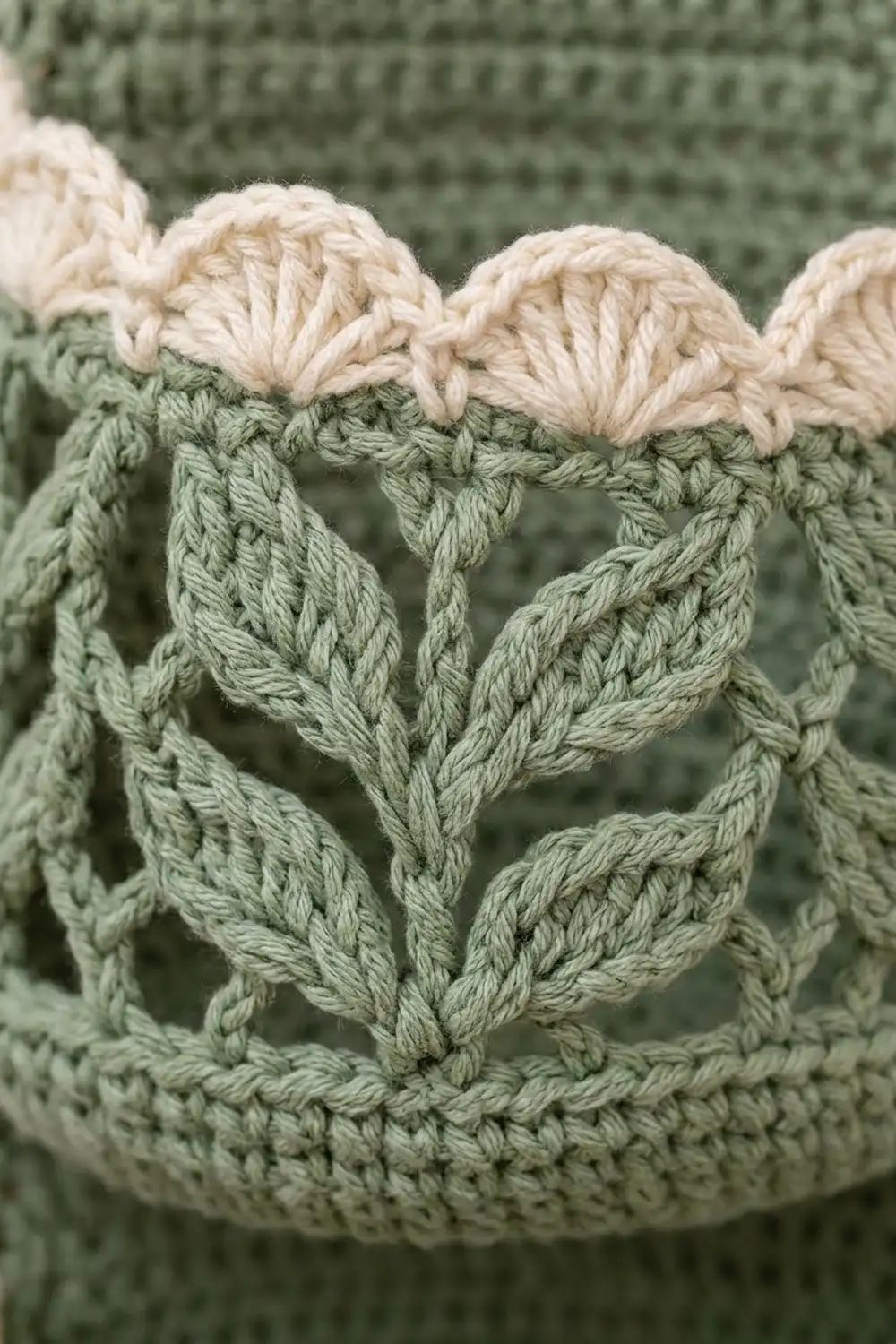
Pocket (Make 3)
Work joined rounds in Color A. Do not turn. The join of each round sits at the back of the pocket, where the panel will hide it.
Base
Round 1: Make a magic ring, ch 1, work 6 sc in the ring, join with sl st to first sc. (6 sts)
Round 2: Ch 1, 2 sc in each st around, join. (12 sts)
Round 3:Ch 1, 6 times, join. (18 sts)
Round 4:Ch 1, 6 times, join. (24 sts)
Round 5:Ch 1, 6 times, join. (30 sts)
Round 6:Ch 1, 6 times, join. (36 sts)
Round 7:Ch 1, 6 times, join. (42 sts)
Round 8:Ch 1, 6 times, join. (48 sts)
Round 9:Ch 1, 6 times, join. (54 sts)
Round 10:Ch 1, 6 times, join. (60 sts)
Walls
Round 11: Ch 1, sc in BLO of each st around, join. (60 sts) This makes a crisp ridge and turns the wall upward.
Rounds 12–13: Ch 1, sc in each st around, join. (60 sts)
Leaf Lace Band
The band uses a 6-stitch repeat: 60 sts ÷ 6 = 10 leaf sprigs around the pocket.
Round 14 (V round):Ch 1, sc in first st, 9 times. Then ch 2, skip 2 sts, V in next st, ch 2, skip last 2 sts, and join with sl st to first sc. (10 sc and 10 V-stitches)
Stitch check: 1 + (9 × 6) + 5 = 60 sts used from Round 13.
Round 15 (leaf round):Ch 1, sc in same st as join, 9 times. Then ch 3, Leaf Sprig in ch-3 sp of next V, ch 3, and join with sl st to first sc. (10 sc and 10 sprigs = 30 LC)
Skip the ch-2 spaces of Round 14. The three clusters fan out from one point to form each leaf sprig.
Round 16 (tie round):Ch 4 (counts as tr), 9 times. Then ch 2, sc in top of next LC, ch 1, sc in top of next LC, ch 1, sc in top of next LC, ch 2, and join with sl st to top of beginning ch-4. (10 tr, 30 sc, 20 ch-2 sps, 20 ch-1 sps)
The tr stitches lift the low points between sprigs up to the leaf tips, so the next round is level.
Round 17 (conversion round):Ch 1, 10 times, join. Count: 40 sts worked 1-per-stitch (10 tr and 30 sc) + 20 sts added in the ch-2 sps = 60 sts. Fasten off Color A.
Cream Rim
Round 18: Join Color B at the back join, ch 1, sc in each st around, join. (60 sts)
