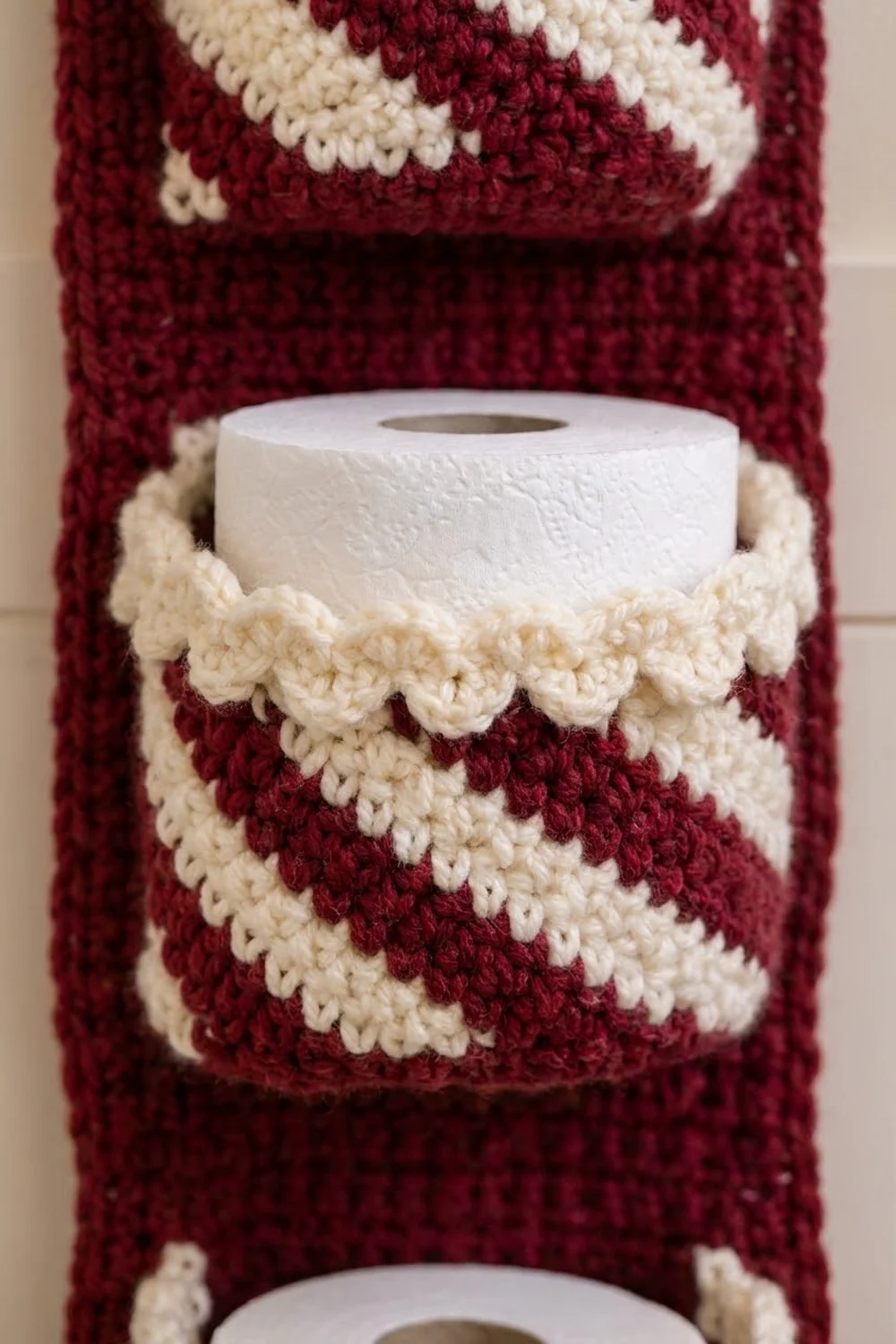
The Peppermint Twist holder adds a little holiday cheer to the bathroom. A tall burgundy panel hangs from two loops, and three round-bottomed pockets each hold one standard roll of toilet paper.
The pockets have burgundy and cream stripes that spiral around the sides like a candy cane. Each one is finished with a cream rim of small scallops. The panel has a tidy two-round edging, so the burgundy frames each pocket.
This pattern uses US crochet terms. The finished panel measures 7 in × 15 in (17.8 cm × 38.1 cm), not counting the hanging tabs. Each pocket is about 4.4 in (11.2 cm) across and 3.75 in (9.5 cm) tall.
To make it, you crochet a rectangular panel in rows and three pockets in joined rounds, starting each pocket from a flat circle. Then you sew the pockets onto the panel, work a border around the panel, and crochet the two tabs directly off the top edge.
Finished Size and Construction
- Finished size: 7 in × 15 in (17.8 cm × 38.1 cm) panel; tabs add about 1.5 in (3.8 cm) of loop above the panel
- Skill level: Intermediate (colorwork in the round)
- Terminology: US
- Yarn weight: Worsted (#4)
- Hook: 5.0 mm (H-8)
- Number of pieces: 4 (1 backing panel, 3 pockets); tabs are worked onto the panel
- Layout: 3 pockets stacked in a single vertical column
- Panel size before border: 6 in × 14 in (15.2 cm × 35.6 cm)
- Pocket size: 4.4 in (11.2 cm) base diameter, 3.75 in (9.5 cm) tall
- Border depth: 0.5 in (1.3 cm) on each side
Materials
Use a smooth worsted-weight acrylic or cotton blend so the stripes stay crisp. Cotton blends make a firmer pocket, and acrylic is lighter and easier to wash. Pick two colors with strong contrast.
- Color B (Burgundy): 220 g, about 440 m
- Color C (Cream): 90 g, about 180 m
These amounts include a margin of roughly 15%. That covers the gauge swatch, the sewing tails, and the strand you carry during colorwork.
Tools:
- 5.0 mm (H-8) crochet hook
- Tapestry needle
- 6 locking stitch markers
- Rustproof pins
- Scissors
- Measuring tape
- Blocking mat and spray bottle
- 1 in (2.5 cm) wooden dowel or towel bar for hanging
Abbreviations (US Terms)
- ch – chain
- sc – single crochet
- dc – double crochet
- sl st – slip stitch
- sk – skip
- st(s) – stitch(es)
- sp – space
- BLO – back loop only
- rep – repeat
- MR – magic ring
- B / C – Burgundy / Cream
Special stitches
- Tapestry sc: Lay the unused color along the top of the round and work over it, so it is hidden inside the stitches. To change color, work the last sc of the old color until 2 loops remain on the hook. Then yarn over with the new color and pull through.
- Scallop: Work 5 dc in the same stitch.
Gauge and Checkpoints
Gauge: 14 sc and 16 rows = 4 in (10.2 cm) in sc worked in rows. That works out to 3.5 sts and 4 rows per inch.
Make one pocket base before you start the panel. Rounds 1–8 should measure 4.4 in (11.2 cm) across. If they do, your gauge matches the pattern.
Checkpoints:
- Panel after Row 16: 6 in wide × 4 in tall (15.2 cm × 10.2 cm)
- Panel after Row 56: 6 in × 14 in (15.2 cm × 35.6 cm)
- Pocket base after Round 8: 4.4 in (11.2 cm) diameter
- Pocket side after Round 20: 3 in (7.6 cm) tall, measured from the base edge
- Finished pocket: 3.75 in (9.5 cm) tall
- Bordered panel: 7 in × 15 in (17.8 cm × 38.1 cm)
If your work is too big, go down half a hook size. If it is too small, go up half a size. Colorwork often tightens your gauge, so check the pocket sides separately from the plain panel.
Backing Panel
With B, ch 22.
Row 1: Sc in the 2nd ch from the hook and in each ch across, turn. (21 sts)
Rows 2–56: Ch 1 (does not count as a st), sc in each st across, turn. (21 sts)
Do not fasten off. Set the panel aside with a stitch marker in the live loop.
Checkpoint: 6 in × 14 in (15.2 cm × 35.6 cm). That is 21 sts ÷ 3.5 = 6 in, and 56 rows ÷ 4 = 14 in.
Pocket (make 3)
Base
With B, make an MR.
Round 1: Ch 1, 6 sc in the ring, sl st to the first sc. (6 sts)
Round 2: Ch 1, 2 sc in each st, sl st to the first sc. (12 sts)
Round 3: Ch 1, sc in the next st, 2 sc in the next st; rep 6 times, sl st to join. (18 sts)
Round 4: Ch 1, sc in the next 2 sts, 2 sc in the next st; rep 6 times, sl st to join. (24 sts)
Round 5: Ch 1, sc in the next 3 sts, 2 sc in the next st; rep 6 times, sl st to join. (30 sts)
Round 6: Ch 1, sc in the next 4 sts, 2 sc in the next st; rep 6 times, sl st to join. (36 sts)
Round 7: Ch 1, sc in the next 5 sts, 2 sc in the next st; rep 6 times, sl st to join. (42 sts)
Round 8: Ch 1, sc in the next 6 sts, 2 sc in the next st; rep 6 times, sl st to join. (48 sts)
Checkpoint: 4.4 in (11.2 cm) diameter. The base should lie flat, without ripples or cupping.
Sides
Round 9: Ch 1, sc in the BLO of each st, sl st to join. (48 sts)
This round makes a crisp fold where the flat base meets the sides.
For Rounds 10–20, join C and work tapestry sc, carrying the unused color. Start each round with ch 1 and end it with a sl st to the first sc. Each round stays at 48 sts.
