
Round 4: Sc in next 2 sts, sc2tog; repeat around. (36 sts)*
Round 5: Sc in next st, sc2tog; repeat around. (24 sts)*
Round 6: Sc2tog 12 times. (12 sts)
Round 7: Sc2tog 6 times. (6 sts)
Fasten off, then weave the tail through the front loops and pull it closed. These quick decreases pull the bottom points in and give the cup its rounded bottom.
Pocket Rim (Work on Each Ring)
Round 1 (B): Join B at a top seam. Sc2tog through the two corner sps that meet there. Sc in next 8 sts, 3 sc in the top point ch-2 sp, sc in next 8 sts, sc2tog at the next seam; repeat from * around, leaving out the final sc2tog. Sl st to the first st. (20 sts per hexagon × 4 = 80 sts)*
Round 2 (B): Ch 1. Work rsc in each st around, then sl st to join and fasten off. (80 rsc)
The rim count comes from the same per-hexagon count as the joining: 4 hexagons × 20 sts = 80. The 3 sc at each point keep the peaks sharp, and the sc2tog at each seam keeps the dips crisp.
Back Panel
Row 1 (A): Ch 65. Sc in 2nd ch from hook and in each ch across, then turn. (64 sc)
Rows 2–8: Ch 1, sc in each st across, turn. (64 sc)
Row 9 (decrease row): Ch 1, sc2tog, sc to the last 2 sts, sc2tog, turn. (62 sc)
Row 10: Ch 1, sc in each st across, turn. (62 sc)
Rows 11–68: Repeat Rows 9–10. Each odd row ends with (71 minus the row number) sts. (Row 29: 42 sc. Row 49: 22 sc. Row 67: 4 sc. Row 68: 4 sc.)
Row 69: Ch 1, sc2tog twice, turn. (2 sc)
Row 70: Ch 1, sc2tog. Do not fasten off. (1 sc, the apex)
Checkpoint: The panel is 16 in (40.6 cm) wide and 15.5 in (39.4 cm) tall. Each slanted edge has 69 row ends below the apex stitch.
Border
Border gauge: 4 sc per inch along the edges, the same as the panel.
Round 1: Ch 1. Work 3 sc in the apex st. Down the left side, sc once in each row end of Rows 69 to 1 (69 sc). Work 3 sc in the first foundation loop, which is the bottom corner. Sc in the next 62 foundation loops. Work 3 sc in the last foundation loop, the second bottom corner. Up the right side, sc once in each row end of Rows 1 to 69 (69 sc). Sl st to the first sc.
(Apex 3 + side 69 + corner 3 + bottom 62 + corner 3 + side 69 = 209 sts)
Round 2: Ch 1. Sc in each st, with these changes. At the apex, sc in the first st, work (sc, ch 20, sc) in the center st for the loop, then sc in the third st. At each bottom corner, work 2 sc in each of the 3 corner sts. Sl st to join.
(209 worked one per st + 7 extra = 216 sc, plus the ch-20 loop. Per side: 69 slanted, 62 bottom, 6 at each corner, 4 at the apex.)
Round 3: Ch 1. Sc in each sc around, and work 30 sc into the ch-20 loop. At each bottom corner, work (sc in next st, 2 sc in next st) 3 times over the 6 corner sts. Sl st to join and fasten off.
(216 worked one per st + 30 in the loop + 6 corner increases = 252 sts)
Why the math works: The bottom 3 + 62 + 3 uses all 64 foundation loops. Each slanted side uses one sc per row end. At 4 sc per inch, 69 sc covers 17.25 in (43.8 cm), while the slanted edge is about 17.7 in (45.0 cm) long. That slight easing keeps the long sides from rippling. Increasing at the corners on Rounds 2 and 3 rounds them off smoothly. Three rounds at 4.5 rounds per inch add 0.7 in (1.8 cm) on each side, so the width grows from 16 in to 17.4 in (40.6 cm to 44.2 cm).
Final Blocking
- Weave in all ends and leave the pockets unattached.
- Pin the panel on the mat at 17.4 in (44.2 cm) wide and 16.9 in (42.9 cm) tall, keeping the slanted sides straight.
- Shape each bottom corner into a smooth curve with pins.
- Mist the panel with water until it is damp, then let it dry completely.
- Slip each pocket over a roll or jar 4.4 in (11.2 cm) across. Pinch the rim points upward, mist, and let dry.
- Lay each pocket so one hexagon sits flat against the panel. This is its back hexagon.
- Bottom pockets: Center each back hexagon 2.5 in (6.4 cm) to the left or right of the center line, with its bottom point at Row 8, which is 1.8 in (4.6 cm) up from the bottom edge.
- Top pocket: Center the back hexagon on the center line, with its bottom point at Row 34, which is 7.6 in (19.3 cm) up.
- Use A to whipstitch around the back hexagon’s two vertical sides and two lower sides, then tack its top point. Sew snugly so the panel doesn’t pucker.
Final Quality-Control Checklist
- Each hexagon has 8 sc per side and measures 4 in (10.2 cm) point to point
- Each ring measures 13.9 in (35.3 cm) around
- Each base closes neatly with 6 sts
- Each rim has 80 sts with four sharp peaks
- The panel border counts 209, then 216, then 252 sts
- Bottom corners are rounded and the loop is fully covered
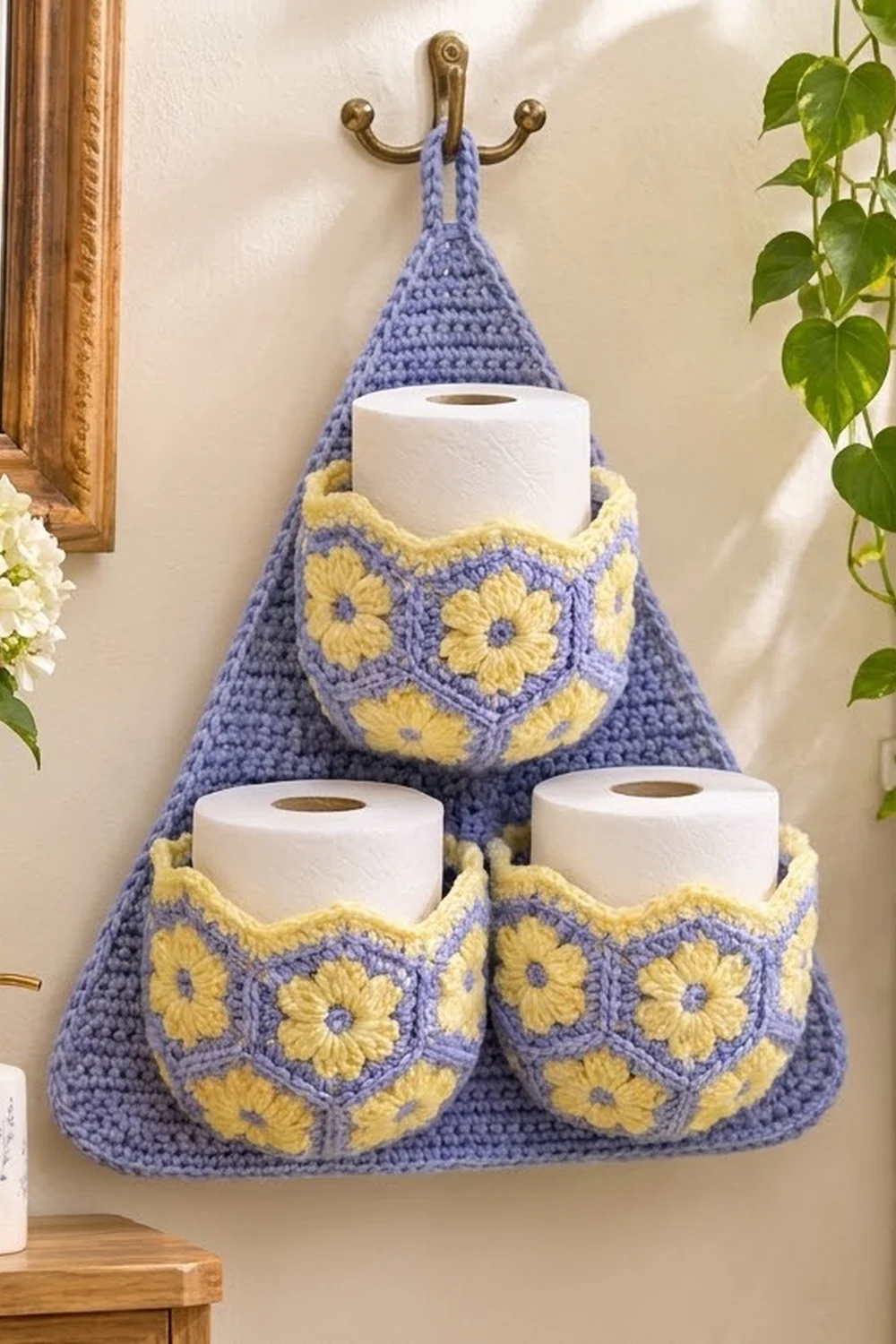
- The three pockets are level and evenly spaced
- A roll slides in easily and stays put
Troubleshooting
The puffs look flat. Pull up each loop to the height of the ch-3 before working the next one.
The hexagon cups. Check that each Round 3 group is (3 dc, ch 2, 3 dc), or loosen your tension.
The hexagon ruffles. Use a smaller hook or work the Round 4 corners as (sc, ch 1, sc).
The roll doesn’t fit. Your ring is under 13.9 in (35.3 cm). Rework the hexagons with a bigger hook.
The slanted edges wave. Check that you worked only 69 sc per side on Border Round 1.
The panel sags under the pockets. Tighten the whipstitching and tack each base’s center to the panel.
Care
Hand wash in cool water and reshape while damp. Dry flat, then rehang.
Final Notes
Everything depends on the hexagon. If you get 8 sc per side and 2 in (5.1 cm) sides, each ring measures 13.9 in (35.3 cm) around. Then 72 stitches gather into the base and 80 form the rim. The panel works the same way: 64 sc gives 16 in (40.6 cm) of width, 70 rows give 15.5 in (39.4 cm) of height, and the 209/216/252 border brings the panel to 17.4 × 16.9 in (44.2 × 42.9 cm). Check each measurement before moving to the next stage, and your three periwinkle pockets will hold their rolls neatly.
Happy crocheting!
