
Rows 2–21: Ch 1, turn, and sc in each st. (39)
This straight section will be hidden behind the bottom pockets. Check the width now: 9.75 in (24.8 cm).
Row 22 (decrease row): Ch 1, turn. Sc2tog, sc to the last 2 sts, sc2tog. (37)
Row 23: Ch 1, turn, and sc in each st. (37)
Rows 24–56: Repeat Rows 22–23. Every even row is a decrease row, and every odd row is worked even. Count checkpoints:
- Row 38: 21 sts
- Row 39: 21 sts
- Row 48: 11 sts
- Row 56: 3 sts
Row 57: Ch 1, turn, and sc3tog. (1) Fasten off.
The panel now has a 21-row straight bottom section topped by a sloped point. It measures about 12.75 in (32.4 cm) tall.
Hanging Tab
Row 1 (Color C): Ch 7. Sc in the 2nd ch from the hook and in each ch across. (6)
Rows 2–24: Ch 1, turn, and sc in each st. (6)
Fasten off and leave a long tail. The tab measures 1.5 in (3.8 cm) × 5.25 in (13.3 cm).
Make All Pieces
- Color A: 3 pockets (body), 3 motif centers and surrounds, 1 panel
- Color B: 3 pocket stripes, 3 sets of petals, 3 motif outlines, panel border
- Color C: 1 tab
Layout, as seen from the front:
Joining
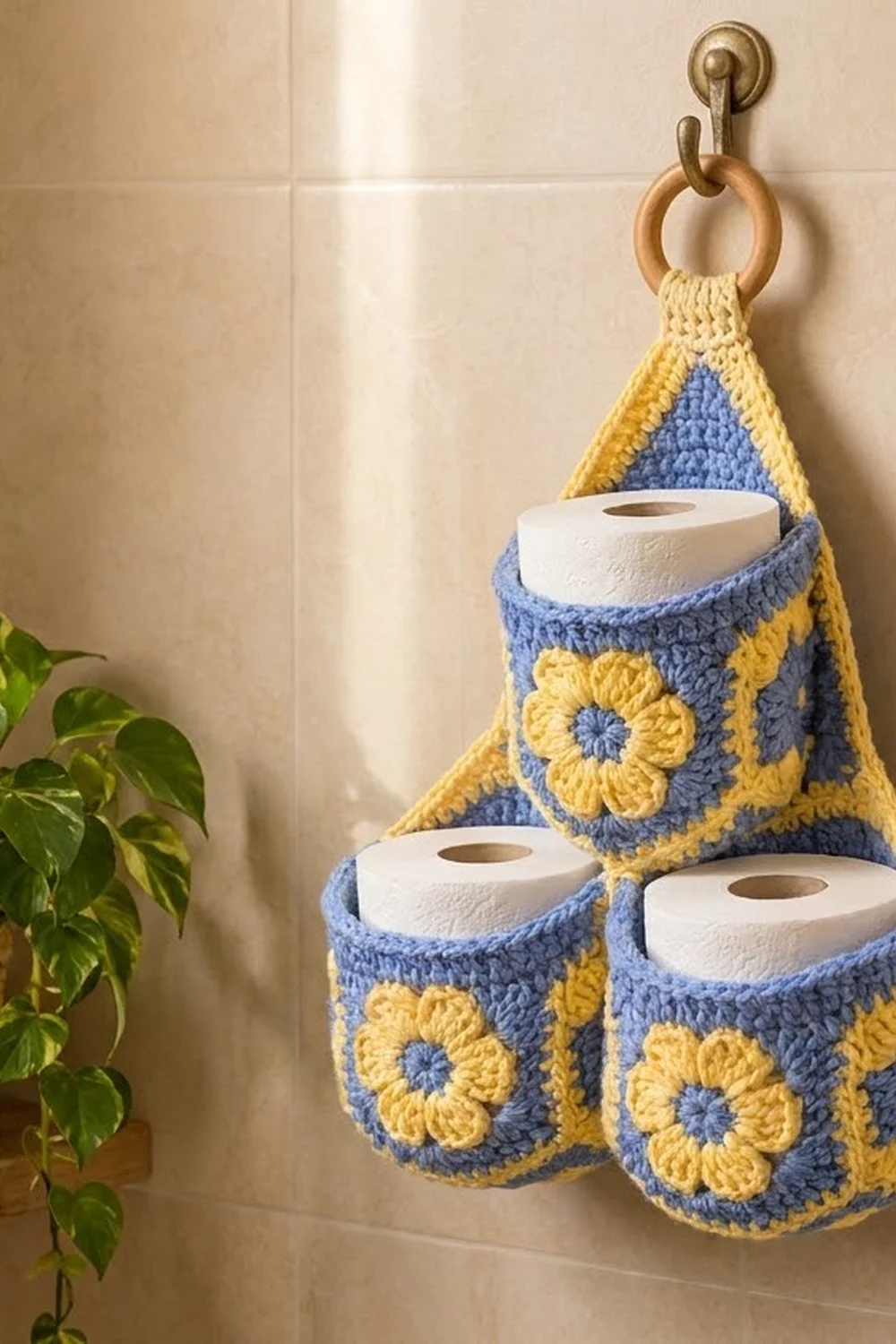
Motifs to pockets: Center each motif on the front face of its pocket with the flat edges at the top and bottom. Its lower edge should sit 0.25 in (0.6 cm) above the base fold, which leaves 0.5 in (1.3 cm) of blue below the stripe at the top. The motif’s 4 in (10.2 cm) width curves slightly around the sides of the pocket.
Pin the motif in place and whipstitch through the back loops of the Rnd 5 sts with the Color B tail. Put a roll inside while you sew so the motif doesn’t pucker.
Panel border first: Work the border (next section) before sewing the pockets on.
Pockets to panel: Use Color A and whipstitch.
The panel and pocket walls have the same row gauge, so the joins match stitch for stitch:
– each pocket round matches 1 panel row on the vertical seams
– each pocket stitch matches 1 panel stitch on the horizontal seams
To find the right columns, count stitches across Row 1 for the bottom pockets and Row 21 for the top pocket.
- Pocket 1 (bottom left): Place its back face over Rows 1–19, sts 4–14, counting from the right-hand edge with the front of the panel facing you.
- Pocket 2 (bottom right): Place its back face over Rows 1–19, sts 26–36.
- Pocket 3 (top): Place its back face over Rows 21–39, sts 15–25, centered on st 20. Row 21 still has all 39 sts, so this count is exact.
For each pocket, sew 3 seams:
– Base edge: the 11 sts along the bottom of the back face to the 11 panel sts in that row (Row 1 for the bottom pockets, Row 21 for the top pocket)
– Sides: both vertical marker lines (19 rounds each) to 19 panel rows
– Rim: the 11 rim sts to the 11 panel sts in the top row of the placement (Row 19 or Row 39)
The bottom pockets’ centers are 22 sts, or 5.5 in (14.0 cm), apart. That equals one pocket’s width, so their sides just touch. Pocket 3’s base rests on their rims across the Row 20 gap.
Tension: Pull each stitch snug but not tight. A seam that’s too tight will pull dimples into the panel.
Size checkpoint: The width across the bottom pockets should be 11 in (27.9 cm).
Border
Work the border on the panel before attaching the pockets. Use Color B and the same gauge: 4 sts per inch along each edge. Each ch-2 corner sp is a corner and is not counted in any side.
Rnd 1: With the right side facing, join at the bottom right corner.
- Bottom edge: sc in each of the 39 foundation chs. (39)
- Bottom left corner: ch 2.
- Left side, going up:
- Rows 1–21 (straight section): sc in each row end, but skip the row ends of Rows 7 and 14. (19 sc)
- Rows 22–57 (slope): sc in each row end, with 2 sc in the row end of Row 40. (37 sc)
- Left side total: 56 sc.
- Tip: ch 2.
- Right side, going down: Work it as a mirror of the left side. (56 sc)
- Bottom right corner: ch 2, then join.
Round total: 151 sc and 3 ch-2 corners.
Rnd 2: Sl st into the corner sp and work (sc, ch 2, sc) in it. Sc in each sc along each side, and work (sc, ch 2, sc) in each corner. Join and fasten off.
Each side gets its existing stitches plus 1 stitch from each corner:
– bottom: 39 + 2 = 41
– each side: 56 + 2 = 58
Round total: 157 sc and 3 ch-2 corners.
Why the math works:
– Bottom edge: 39 sts at 4 per inch is 9.75 in (24.8 cm).
– Straight side section: 21 rows is about 4.67 in, which needs about 19 sc.
– Slope: it rises 8 in (20.3 cm) over 36 rows and moves in 19 sts, or 4.75 in (12.1 cm). That makes the slanted edge about 9.3 in long, which needs 37 sc.
Matching the edge length keeps the border flat, with no ruffling or cupping. With the border on, the panel is 10.75 in (27.3 cm) × 13.75 in (34.9 cm).
Tab: Fold the tab through the ring. Sew both ends to the back of the panel tip, overlapping it by 1.25 in (3.2 cm). The ring should sit about 1 in (2.5 cm) above the tip.
Final Blocking
- Lightly mist the whole holder with water.
- Put a roll in each pocket to shape the walls.
- Lay the holder flat on its back, pin the panel edges straight and the tip sharp, then pat the motifs flat.
- Check the measurements: 13.75 in (34.9 cm) panel height and 11 in (27.9 cm) across the pockets.
- Let it dry completely with the rolls still inside.
- Remove the pins and weave in any remaining ends.
Final Quality-Control Checklist
- Each pocket has 66 sts and is 4.25 in (10.8 cm) deep.
- All three motifs face forward, with flat edges at the top and bottom.
- The bottom pockets touch and sit level with the panel bottom.
- The top pocket is centered on st 20.
- The border lies flat, with 3 sharp corners.
- The tab is secure and the ring hangs straight.
- All ends are woven in at least 2 in (5.1 cm).
Troubleshooting
- The base cups before Rnd 12: Your tension is too tight. Go up a hook size.
- The base ruffles: Your tension is too loose. Go down a hook size.
- The walls flare outward: Check that every wall round has exactly 66 sts.
- The petals flop forward: Keep the Rnd 3 chains firm behind the petals.
- The border ripples: Skip one more row end on each side.
- The border cups: Add one more sc on each side.
- The holder tilts on the hook: Re-sew the tab so it’s centered on the tip.
Care
Hand wash in cool water, press out the water in a towel and dry flat with rolls inside to keep the shape. Don’t tumble dry.
Final Notes
Each measurement leads to the next:
– Gauge: 16 sc × 18 rows = 4 in (10.2 cm).
– Pocket base: 11 sts per side, 5.5 in (14.0 cm) point-to-point.
– Walls: 19 rounds, 4.25 in (10.8 cm) deep.
– Panel: 39 sts wide, 9.75 in (24.8 cm). It’s 57 rows tall, about 12.75 in (32.4 cm).
– Border: brings the panel to 10.75 in (27.3 cm) × 13.75 in (34.9 cm).
– Pocket spacing: 22 sts, so the bottom pockets fill 11 in (27.9 cm).
If you match the gauge, everything else lines up.
Happy crocheting!
