
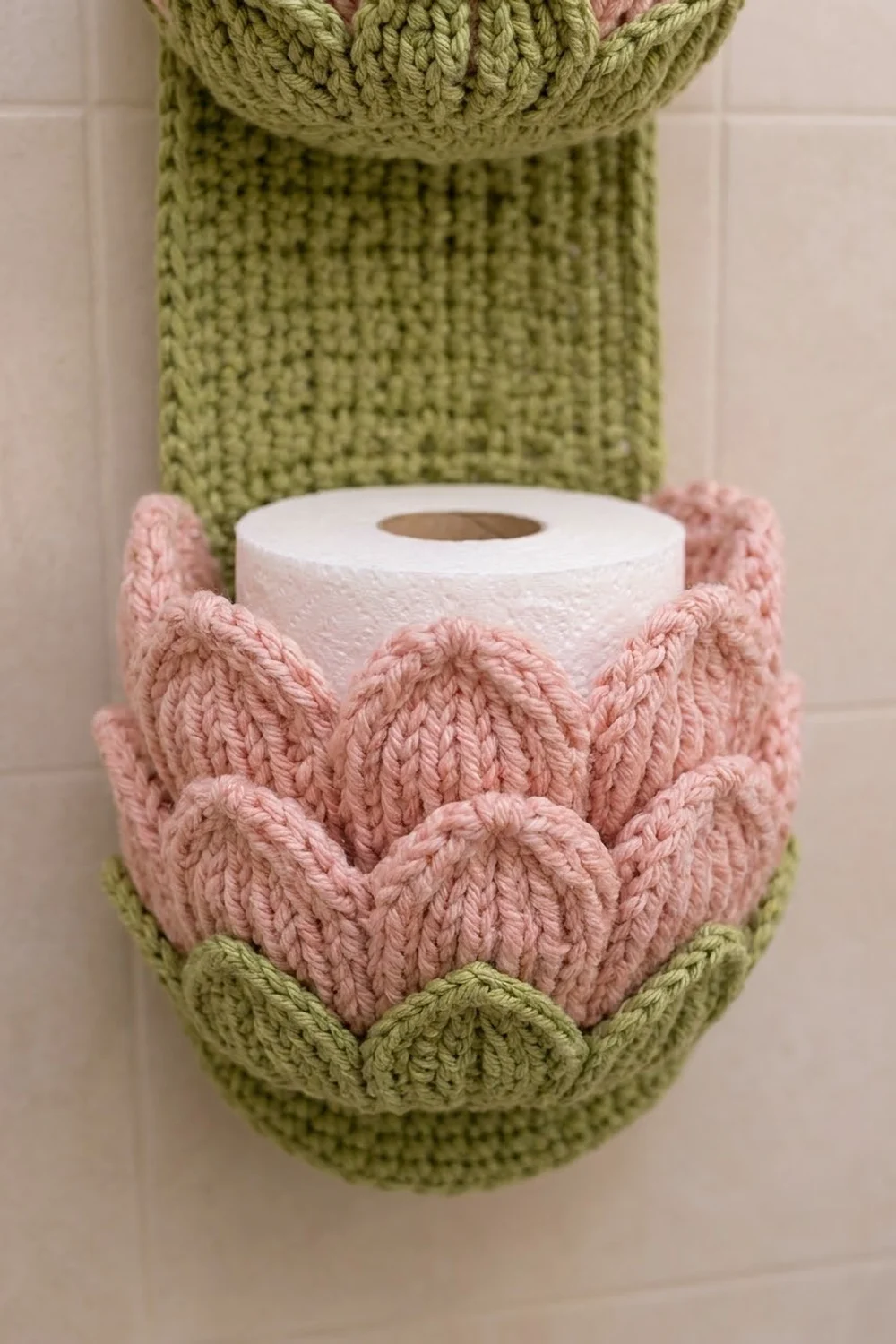
This hanging holder stores three spare rolls in a row of lotus-shaped pockets. A long sage-green backing panel with a rounded top and a hanging loop goes on a hook or towel knob. Three round baskets are sewn to the front, each one wrapped in pointed pink petals over a ring of small green leaves.
The palette is just two colors: sage green for the panel, the basket bases and the leaves, and soft dusty pink for the upper basket walls and two staggered tiers of petals. The petals are worked in back-loop rows, which gives each one a raised, ribbed texture that looks a little like knitting.
The pattern uses US crochet terms. The finished holder measures 4.5 in (11.4 cm) wide at the panel and 19.5 in (49.5 cm) tall without the loop, or 21.5 in (54.6 cm) with it. Each pocket is 5 in (12.7 cm) across and holds a standard roll.
Construction is simple. You crochet one flat panel in rows and give it a single-round border with a hanging loop. Then you make three pockets in the round from the base up, adding leaves and petals into spare front loops. Finally you sew the pockets onto the panel at set row positions.
Finished Size and Construction
- Finished size: 4.5 in (11.4 cm) wide x 19.5 in (49.5 cm) tall; 21.5 in (54.6 cm) including loop
- Skill level: Intermediate
- Terminology: US
- Yarn weight: Worsted (#4), cotton or cotton blend
- Hook: 5.0 mm (H-8)
- Number of pieces: 4 (1 back panel + 3 pockets)
- Layout: 3 pockets stacked vertically on 1 panel
- Pocket size: 5 in (12.7 cm) diameter, 3 in (7.6 cm) wall, 4 in (10.2 cm) to petal tips
- Panel size before border: 4 in (10.2 cm) x 19 in (48.3 cm)
- Border depth: 0.25 in (0.6 cm)
Materials
Choose a smooth worsted-weight cotton or cotton blend. Cotton holds the basket shape, and it stands up to a damp bathroom better than wool does. Stay away from fuzzy or very drapey yarns, because the pockets need to stand up on their own. A tight twist also shows off the ribbed petal texture best.
- Sage green: 220 g / 440 m (approx. 480 yd)
- Dusty pink: 250 g / 500 m (approx. 547 yd)
Tools:
- 5.0 mm (H-8) crochet hook
- Tapestry needle
- 8–10 locking stitch markers
- Measuring tape
- Rustproof pins and a blocking mat
- Scissors
- One toilet roll for fit tests and blocking
These quantities include a margin of about 10% for your gauge swatch and weaving in ends.
Abbreviations (US Terms)
- ch – chain
- sc – single crochet
- sc2tog – single crochet 2 together
- sl st – slip stitch
- st(s) – stitch(es)
- BLO / FLO – back loop only / front loop only
- rnd – round
- inc – 2 sc in the same st
Special stitch – Petal (worked over 6 front loops):
Row 1: ch 1, sc in FLO of each of the next 6 sts, turn (6).
Rows 2–4: ch 1, sc in BLO across, turn (6).
Row 5: ch 1, sc2tog, sc in next 2, sc2tog, turn (4).
Row 6: ch 1, sc in BLO across, turn (4).
Row 7: ch 1, (sc2tog) twice, turn (2).
Row 8: ch 1, sc2tog (1).
Then sl st 7 times down the side edge nearest the next unworked front loop, ending at the base. The petal is 6 sts wide and 2 in (5.1 cm) tall.
Special stitch – Leaf (worked over 6 front loops):
Row 1: ch 1, sc in FLO of each of the next 6 sts, turn (6).
Row 2: ch 1, sc2tog, sc in next 2, sc2tog, turn (4).
Row 3: ch 1, (sc2tog) twice, turn (2).
Row 4: ch 1, sc2tog (1).
Then sl st 3 times down the side edge nearest the next unworked front loop. The leaf is 1 in (2.5 cm) tall.
Gauge and Checkpoints
Gauge: 14 sc x 16 rows = 4 in (10.2 cm) in sc worked in rows.
Make one complete pocket before you start the panel. The pocket is a better test than a flat swatch, since it shows whether a roll fits and how firm the walls are.
- After Rnd 10 (base): 5 in (12.7 cm) across.
- After Rnd 22 (wall): wall is 3 in (7.6 cm) tall from the fold.
- After petals: 4 in (10.2 cm) from base to the tips of the inner petals.
- Panel after Row 72: 4 in (10.2 cm) x 18 in (45.7 cm).
If your base is too big (over 5.25 in / 13.3 cm), go down to a 4.5 mm hook. If it is too small (under 4.75 in / 12.1 cm), go up to a 5.5 mm hook. Test the fit with a roll after Rnd 22, then use the same hook for every piece.
Soft walls that fold over are a sign your tension is loose. Go down a hook size even if the base measurement is close.
Back Panel
With green, ch 15.
Row 1: Sc in 2nd ch from hook and in each ch across, turn. (14 sc)
Rows 2–72: Ch 1, sc in each st across, turn. (14 sc)
Checkpoint: 4 in (10.2 cm) wide x 18 in (45.7 cm) long.
Row 73: Ch 1, sc2tog, sc in next 10, sc2tog, turn. (12 sc)
Row 74: Ch 1, sc2tog, sc in next 8, sc2tog, turn. (10 sc)
Row 75: Ch 1, sc2tog, sc in next 6, sc2tog, turn. (8 sc)
Row 76: Ch 1, sc2tog, sc in next 4, sc2tog. (6 sc) Do not fasten off.
These four rows narrow the top into the rounded arch. Panel before border: 4 in (10.2 cm) x 19 in (48.3 cm).
Pocket (make 3)
Base
With green, make a magic ring.
Rnd 1: 6 sc in ring, join with sl st to first sc. (6)
Rnd 2: Ch 1, inc in each st, join. (12)
Rnd 3: Ch 1, (sc 1, inc) around, join. (18)
Rnd 4: Ch 1, (sc 2, inc) around, join. (24)
Rnd 5: Ch 1, (sc 3, inc) around, join. (30)
Rnd 6: Ch 1, (sc 4, inc) around, join. (36)
Rnd 7: Ch 1, (sc 5, inc) around, join. (42)
Rnd 8: Ch 1, (sc 6, inc) around, join. (48)
Rnd 9: Ch 1, (sc 7, inc) around, join. (54)
Rnd 10: Ch 1, (sc 8, inc) around, join. (60)
Checkpoint: flat disc, 5 in (12.7 cm) across.
