
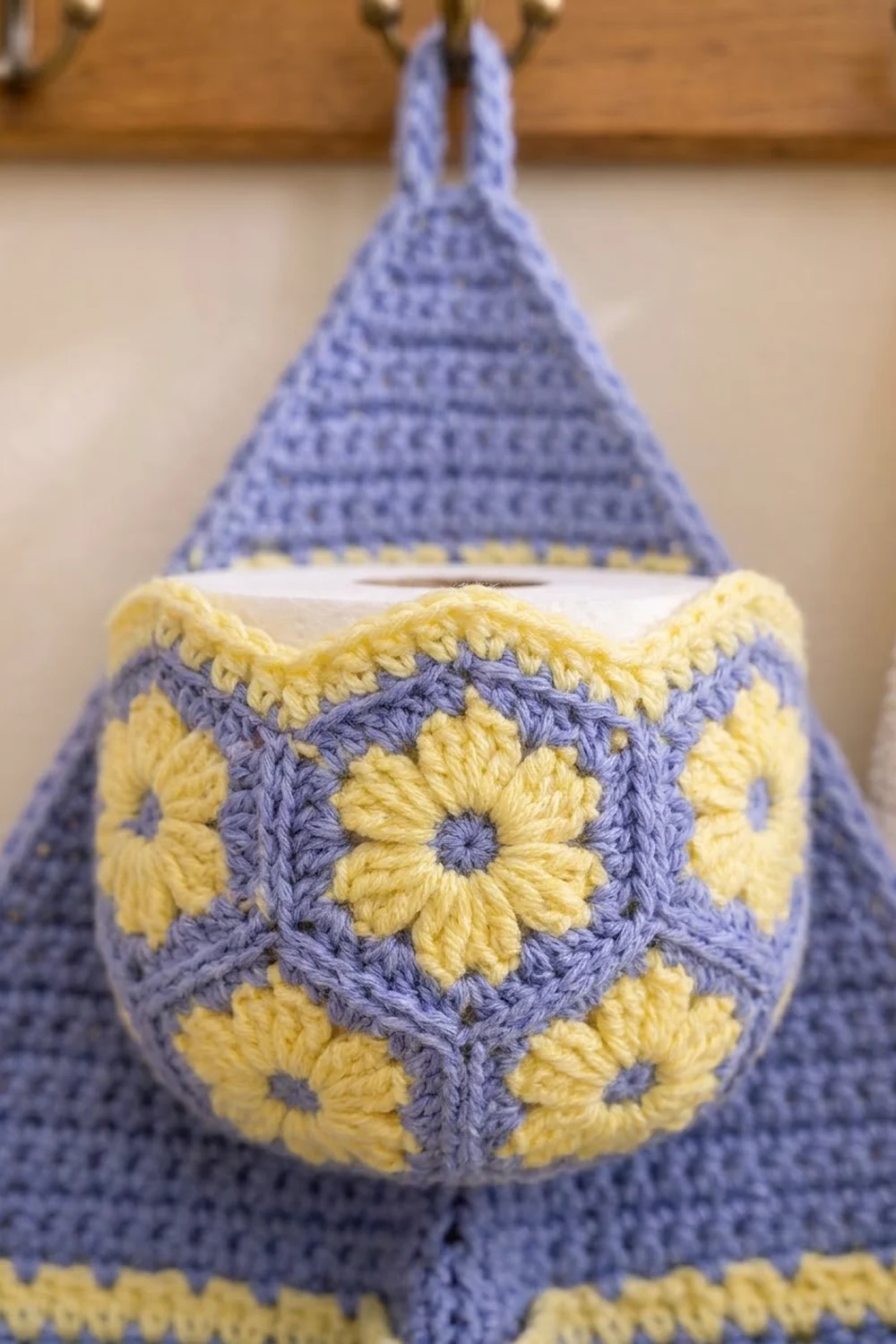
This hanging holder stores three spare toilet rolls. A periwinkle triangle hangs from a hook, and three round pockets made of daisy hexagons each hold one roll. One pocket sits at the top and two sit side by side below it.
The colors are periwinkle blue (Color A) and pale buttery yellow (Color B). Each hexagon has a yellow puff-petal flower around a blue center. Each pocket has a yellow corded rim that rises and dips with the hexagon points. The look is cottage-style and cheerful, and the cotton yarn suits a bathroom.
This pattern uses US crochet terms. The finished holder measures 17.4 in (44.2 cm) wide and 16.9 in (42.9 cm) tall, plus a 2 in (5.1 cm) hanging loop.
Construction overview: You make 12 hexagons and join them into three rings of four. Each ring gets a gathered base at the bottom and a corded rim at the top. Then you crochet the triangular panel in rows, add a border with a built-in loop, block everything, and sew on the pockets.
Finished Size and Construction
- Finished size: 17.4 in (44.2 cm) wide × 16.9 in (42.9 cm) tall, plus a 2 in (5.1 cm) loop
- Skill level: Intermediate
- Terminology: US
- Yarn weight: Worsted (#4), cotton
- Hook: 4.5 mm (US 7)
- Number of pieces: 1 back panel + 12 hexagons (3 pockets of 4 hexagons each)
- Layout: 1 pocket centered at the top, 2 pockets side by side at the bottom
- Hexagon size: 4 in (10.2 cm) point to point, 3.5 in (8.9 cm) flat to flat, 2 in (5.1 cm) per side
- Pocket size: 4.4 in (11.2 cm) diameter, 13.9 in (35.3 cm) around
- Panel size before border: 16 in (40.6 cm) wide × 15.5 in (39.4 cm) tall
- Border depth: 0.7 in (1.8 cm)
Materials
Use a smooth worsted-weight cotton or cotton blend of about 170 m per 100 g. Cotton holds its shape, stays firm, and copes with bathroom humidity. Avoid fuzzy yarns, because they hide the petal texture.
- Color A, periwinkle blue: 260 g (about 442 m)
- Color B, pale yellow: 60 g (about 102 m)
- 4.5 mm (US 7) crochet hook
- Tapestry needle
- 6–8 stitch markers
- Rustproof pins
- Scissors
- Blocking mat
- A toilet roll or jar about 4.4 in (11.2 cm) across, for shaping pockets
These quantities include a margin of about 15% for swatching and joining.
Abbreviations (US Terms)
- ch: chain
- sl st: slip stitch
- sc: single crochet
- dc: double crochet
- sc2tog: single crochet 2 together
- rsc: reverse single crochet (crab stitch)
- sp: space
- st(s): stitch(es)
- RS: right side
Puff stitch:4 times (9 loops on hook). Yarn over and pull through all 9 loops, then ch 1 to lock. The locking ch does not count as a stitch.
Beginning puff:Ch 2. 3 times (7 loops on hook). Yarn over and pull through all 7 loops, then ch 1 to lock. Counts as 1 puff.
Gauge and Checkpoints
Panel gauge: 16 sc × 18 rows = 4 in (10.2 cm).
Make one hexagon before anything else and measure it flat after a light steam:
- After Round 2: 2.25 in (5.7 cm) across
- After Round 3: 3.5 in (8.9 cm) point to point
- After Round 4: 4 in (10.2 cm) point to point, 2 in (5.1 cm) per side
If your hexagon is too big: go down to a 4 mm hook. Pockets will gape and drop rolls.
If it is too small: go up to a 5 mm hook. The ring must measure 13.9 in (35.3 cm) around to hold a standard roll.
For the panel, check that Row 1 measures 16 in (40.6 cm) and that Rows 1–8 measure 1.8 in (4.6 cm).
Hexagon Motif (Make 12)
Round 1 (A): Make a magic ring, ch 1, work 6 sc in the ring, then sl st to the first sc. Fasten off. (6 sc)
Round 2 (B): Join B in any sc. Work a beginning puff in the same st, ch 3. Puff in next sc, ch 3; repeat from * 4 more times. Sl st to the top of the beginning puff and fasten off. (6 puffs, 6 ch-3 sps)*
Round 3 (A): Join A in any ch-3 sp. Ch 3 (counts as dc), then (2 dc, ch 2, 3 dc) in the same sp. (3 dc, ch 2, 3 dc) in next ch-3 sp; repeat from * 4 more times. Sl st to the top of ch-3. (36 dc, 6 ch-2 corner sps; 6 dc per side)*
Round 4 (A): Ch 1. Sc in each dc around, working (sc, ch 2, sc) in each ch-2 corner sp. Sl st to the first sc and fasten off, leaving a 12 in (30.5 cm) tail. (48 sc, 6 ch-2 corner sps)
Round 4 is a conversion round: 36 sc worked one per dc, plus 12 extra sc (2 per corner), gives 48. Each side has 8 sc between corner spaces. In this pattern, the corner ch-2 spaces are not counted as stitches.
Make All Pieces
- Hexagons: 12 total. Rounds 1, 3, and 4 use A, and Round 2 uses B.
- Rings: 3 rings of 4 hexagons each.
- Panel: 1, worked in A.
Layout on the panel(each is one pocket):
Joining the Pockets
Method: Whipstitch through the back loops with A, working on the wrong side.
Turn each hexagon point-up so it has two vertical sides. Place two hexagons right sides together and match their vertical sides stitch for stitch. Start with one pass through the corner ch-2 spaces, then whipstitch the 8 pairs of sc, and finish with one pass through the next pair of corner spaces. Join the four hexagons in a row, then join the fourth to the first to close the ring.
Tension: Pull each pass until the edges meet but do not ripple. Seams that are too tight make the ring smaller around.
Size checkpoint: The ring should measure 13.9 in (35.3 cm) around and 4 in (10.2 cm) tall at the points. You should see four downward points at the bottom and four upward points at the top.
Pocket Base (Work on Each Ring)
Round 1 (A): With the RS facing, join A at a bottom seam. Sc2tog through the two corner sps that meet there, counting as 1 st. Sc in next 8 sts, sc in the point ch-2 sp, sc in next 8 sts, sc2tog over the corner sps at the next seam; repeat from * around, leaving out the final sc2tog because you already worked it. Sl st to the first st. (18 sts per hexagon × 4 = 72 sts)*
Round 2: Ch 1. Sc in next 4 sts, sc2tog; repeat from * around. (60 sts)*
Round 3: Sc in next 3 sts, sc2tog; repeat around. (48 sts)*
