This cheerful hanging holder stores three spare toilet rolls in deep, sturdy pockets stacked in a pyramid. A pointed blue back panel with a sunny yellow edge carries all three pockets and hangs from a wooden ring on a simple cream tab.
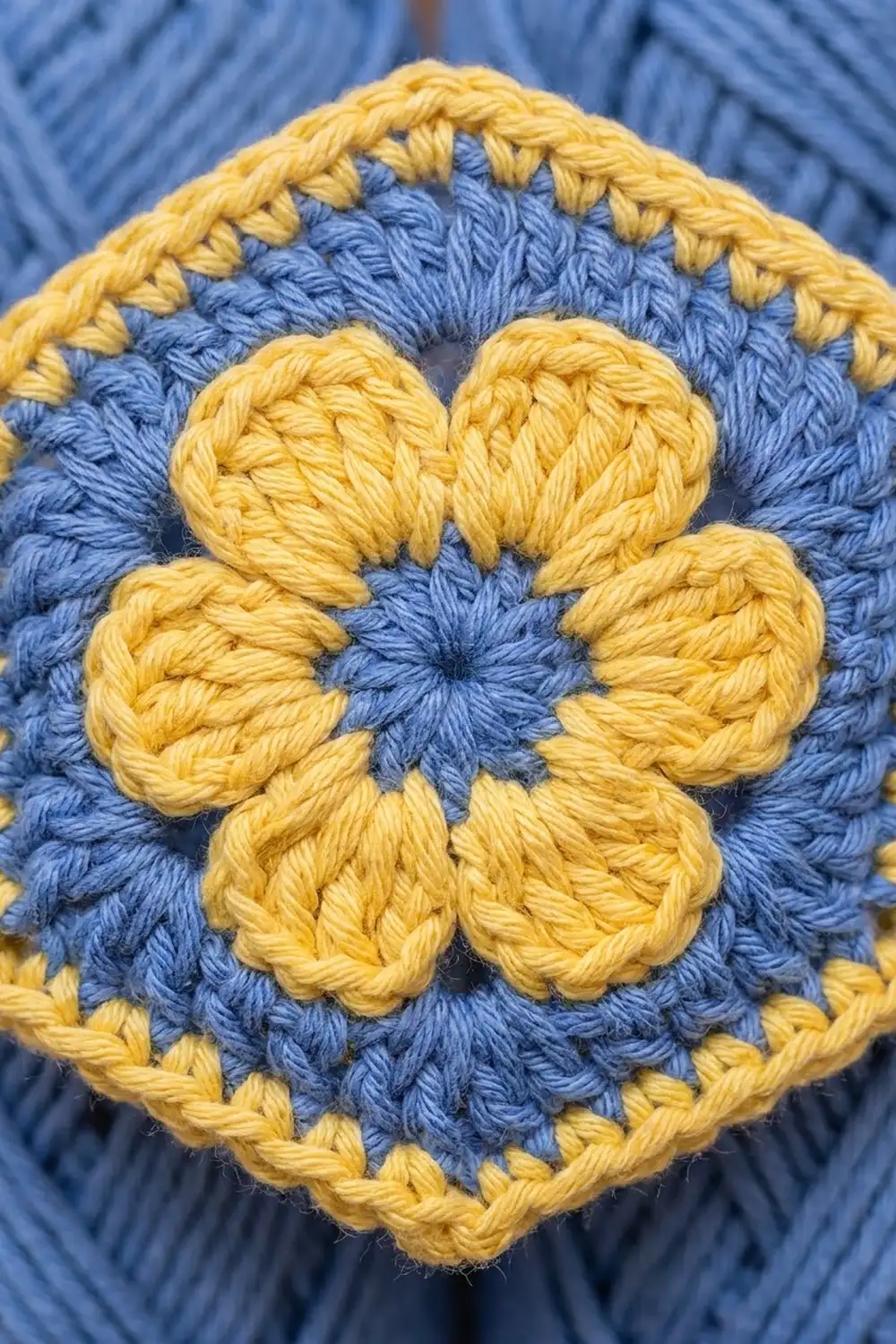
Each pocket has a hexagon flower motif on the front: a blue center, six rounded yellow petals, a blue hexagon surround and a crisp yellow outline. The colors are cornflower blue, sunflower yellow and a soft cream, so it looks bright but not loud in a bathroom.
The pattern uses US crochet terms. The finished holder is 11 in (27.9 cm) wide across the bottom pockets and 13.75 in (34.9 cm) tall from the bottom edge to the panel tip. It measures about 16.5 in (41.9 cm) to the top of the ring. Each pocket is 4.25 in (10.8 cm) deep.
The holder is made in parts. You work three pockets, each with a hexagon base and straight walls, plus three flower motifs, one back panel and one tab. Then you sew the motifs to the pockets, edge the panel, sew the pockets onto the panel and attach the ring.
Finished Size and Construction
- Finished size: 11 in (27.9 cm) wide × 13.75 in (34.9 cm) tall (panel); about 16.5 in (41.9 cm) including the ring
- Skill level: Intermediate
- Terminology: US crochet terms
- Yarn weight: Worsted / medium (#4) cotton
- Hook: US 7 (4.5 mm)
- Number of pieces: 8 (1 panel, 3 pockets, 3 flower motifs, 1 tab)
- Layout: Pyramid: 2 pockets at the bottom, 1 centered above
- Pocket size: 5.5 in (14.0 cm) point-to-point, 4.75 in (12.1 cm) flat-to-flat, 4.25 in (10.8 cm) deep
- Panel size before border: 9.75 in (24.8 cm) × 12.75 in (32.4 cm)
- Border depth: 0.5 in (1.3 cm), 2 rounds
Materials
Use a smooth, firm cotton or cotton blend. Cotton holds its shape when the pockets are full and stands up to bathroom humidity. Avoid splitty or very soft acrylic, because the pockets will sag.
- Color A, cornflower blue: 150 g / 285 m
- Color B, sunflower yellow: 50 g / 95 m
- Color C, pale cream: 10 g / 19 m
All quantities include a safety margin of about 25%.
Tools:
– US 7 (4.5 mm) crochet hook
– Wooden ring, 2.5 in (6.4 cm) across
– Locking stitch markers (at least 6)
– Tapestry needle
– Rust-proof pins
– Scissors
– Measuring tape
Abbreviations (US Terms)
- ch – chain
- sl st – slip stitch
- sc – single crochet
- hdc – half double crochet
- dc – double crochet
- sc2tog – single crochet 2 together
- sc3tog – single crochet 3 together
- BLO – back loop only
- sp – space
- st(s) – stitch(es)
Special stitch: Petal. Work (hdc, 3 dc, hdc) all in the same stitch.
Gauge and Checkpoints
Gauge: 16 sc and 18 rows/rounds = 4 in (10.2 cm) in sc.
Make one complete pocket before you start anything else. The pocket uses the most yarn and tells you whether a roll will fit.
Checkpoints:
– Pocket base, after Rnd 11: 5.5 in (14.0 cm) point-to-point, 4.75 in (12.1 cm) flat-to-flat, with 11 sts on each side.
– Finished pocket: 4.25 in (10.8 cm) deep. A standard roll, about 4.5 in (11.4 cm) wide, should drop in easily.
– Flower motif: 4 in (10.2 cm) point-to-point, 3.5 in (8.9 cm) flat-to-flat.
– Panel, after Row 21: 9.75 in (24.8 cm) wide, about 4.75 in (12.1 cm) tall.
– Panel, after Row 57: about 12.75 in (32.4 cm) tall.
If your work is too big, go down a hook size, or two if the base is still large. If it is too small or a roll won’t fit, go up a hook size. Don’t add stitches, because all the joining positions depend on the counts given here.
Pocket (Make 3)
Use Color A unless stated otherwise. Work in continuous rounds without joining, and move a marker up to the first stitch of each round.
Hexagon base
Rnd 1: 6 sc in a magic ring. (6)
Rnd 2: 2 sc in each st. (12)
Rnd 3: (sc in next st, 2 sc in next st) 6 times. (18)
Rnd 4: (sc in next 2 sts, 2 sc in next st) 6 times. (24)
Rnd 5: (sc in next 3 sts, 2 sc in next st) 6 times. (30)
Rnds 6–11: Keep working the same way. Each round, work 1 more plain sc before each increase, so there are 6 more stitches each time.
- Rnd 6: 36 sts
- Rnd 7: 42 sts
- Rnd 8: 48 sts
- Rnd 9: 54 sts
- Rnd 10: 60 sts
- Rnd 11: (sc in next 9 sts, 2 sc in next st) 6 times. (66)
Because the increases stack, the base forms a flat hexagon with 11 sts on each side. Check the base measurement now.
Walls
Rnd 12 (turning round): sc in BLO of each st. (66) This round sets a crisp fold so the walls stand up.
Rnds 13–28: sc in each st. (66) Work 16 rounds even, keeping the wall straight.
Rnd 29: Change to Color B. sc in each st. (66)
Rnd 30: Change to Color A. sc in each st, then sl st to the first st. (66) Fasten off.
The wall is Rnds 12–30, which is 19 rounds, or 4.25 in (10.8 cm). It has a yellow stripe just below a blue top edge.
Marking the back face: Pick one flat side of the hexagon base. Place markers in the wall stitches directly above its first and last stitch, so the marked face is 11 sts wide. This face will be sewn to the panel. The face directly opposite is the front, where the flower goes.
Flower Motif (Make 3)
Join each round with a sl st to the first stitch.
Rnd 1 (Color A): 12 sc in a magic ring and join. (12 sc) Fasten off.
Rnd 2 (Color B): Join in any st. (Petal in next st, sl st in next st) 6 times. (6 petals, 6 sl sts) Fasten off.
Rnd 3 (Color A): Working behind the petals, join with sc around the post of any sl st from Rnd 2. (Ch 3 behind the next petal, sc around the post of the next sl st) 5 times. Ch 3 and join. (6 sc, 6 ch-3 sps)
Rnd 4 (Color A): Sl st into the first ch-3 sp. Ch 3 (counts as dc), then work (2 dc, ch 2, 3 dc) in the same sp. In each of the remaining 5 ch-3 sps, work (3 dc, ch 2, 3 dc). Join. (36 dc, 6 ch-2 corners; 6 dc per side)
The corners land directly behind the petals, so each petal points at a corner of the hexagon.
Rnd 5 (Color B): Join in any ch-2 corner and work (sc, ch 2, sc) there. Sc in each of the next 6 dc, then (sc, ch 2, sc) in the next corner. Repeat from * around, ending with sc in the last 6 dc, and join. (48 sc, 6 ch-2 corners)
Each side now has 8 sc between corner spaces: 6 sc worked 1 per dc, plus 1 sc from each corner. Leave a 20 in (50.8 cm) tail of Color B for sewing.
Back Panel
The panel is worked in rows with Color A. Ch 1 at the start of each row does not count as a stitch.
Row 1: Ch 40. Sc in the 2nd ch from the hook and in each ch across. (39)
