
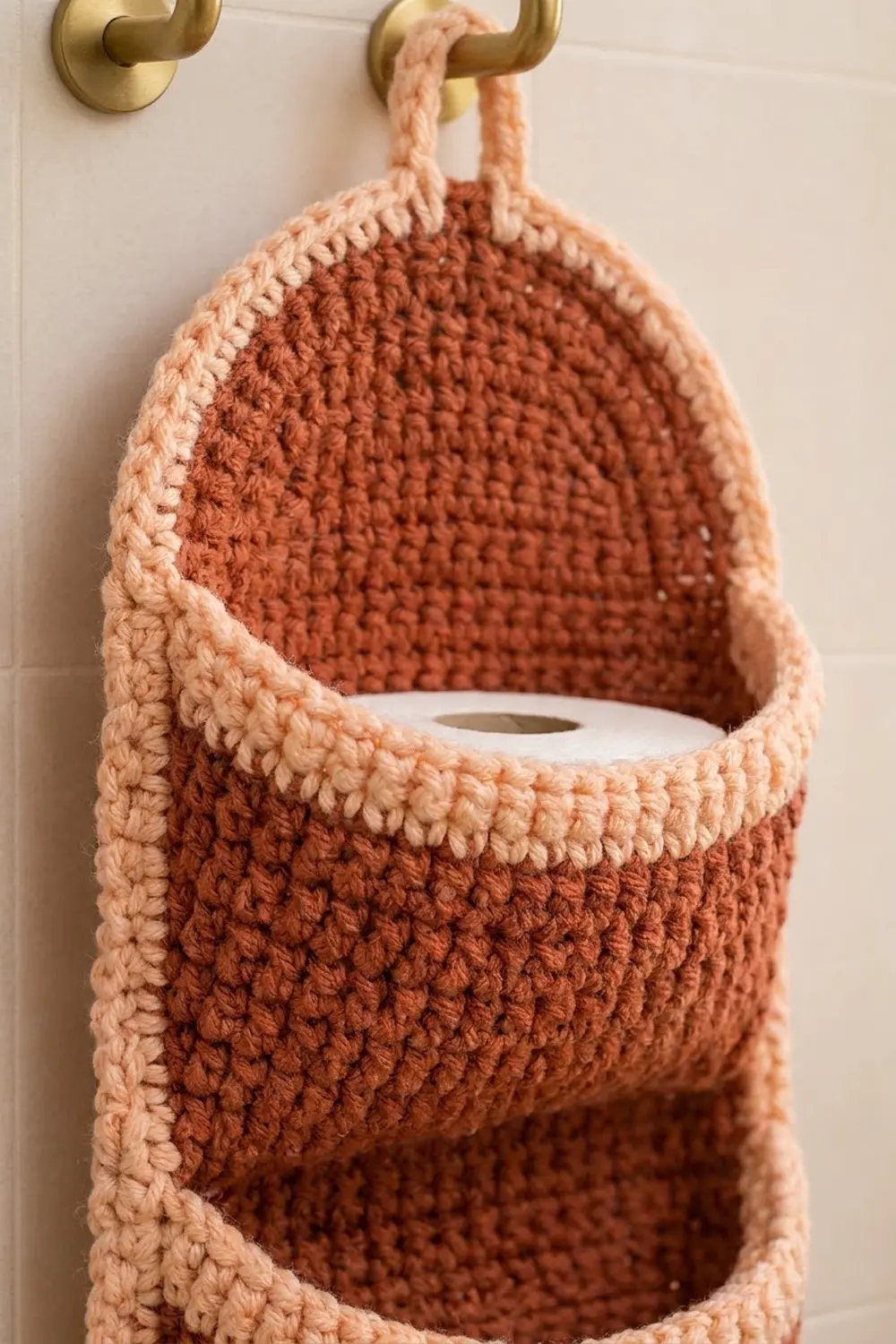
The Terracotta Trio is a long, round-ended wall organizer with three deep pockets. Each pocket holds one standard roll of toilet paper standing upright. The holder hangs from one loop at the top and keeps spare rolls flat against the wall, so they’re easy to reach and take up no shelf space.
The colors are warm and earthy. The back panel and pocket bodies are a rich rust or terracotta, and a soft peach edges the panel and rims each pocket. Everything is single crochet, which gives a dense, firm fabric. It looks good in a bathroom with plants, wood, and brass.
This pattern uses US crochet terms. The finished holder is 7 1/4 in (18.4 cm) wide and 25 in (63.5 cm) long without the loop, or about 27 in (68.6 cm) long with it.
The construction is simple. First you make three identical pockets, each worked like a small oval basket. Then you crochet a back panel with rounded ends in joined rounds around a foundation chain. You sew the pockets onto the panel and finish with a two-round peach border and a hanging loop.
Finished Size and Construction
- Finished size: 7 1/4 in (18.4 cm) × 25 in (63.5 cm), plus a 2 in (5.1 cm) loop
- Skill level: Easy+ (oval rounds, simple sewing)
- Terminology: US
- Yarn weight: Worsted (#4), cotton or cotton blend
- Hook: 5.0 mm (H-8)
- Number of pieces: 4 (1 back panel + 3 pockets)
- Layout: 3 pockets stacked vertically on 1 panel
- Pocket size: base 6 in (15.2 cm) × 5 in (12.7 cm); walls 3 1/4 in (8.3 cm) tall
- Panel size before border: 6 1/4 in (15.9 cm) × 24 in (61.0 cm)
- Border depth: 1/2 in (1.3 cm), 2 rounds
Materials
Choose a firm worsted-weight cotton or cotton blend. Cotton holds its shape when the pockets are full, stays put in bathroom humidity, and stretches very little. Acrylic also works, but the panel can slowly grow longer under the weight of the rolls. Try to use yarn from one dye lot for each color, because a change in shade shows clearly on a large, flat panel.
- Color A – Rust/Terracotta: 300 g (about 460 m)
- Color B – Peach: 80 g (about 123 m)
These amounts include a margin of about 20% for gauge differences, sewing, and weaving in ends.
Tools:
– 5.0 mm (H-8) crochet hook
– 8 locking stitch markers
– Tapestry needle
– Straight pins
– Measuring tape
– Optional: a sturdy wall hook
Abbreviations (US Terms)
- ch – chain
- sc – single crochet
- sl st – slip stitch
- st(s) – stitch(es)
- BLO – back loop only
- inc – 2 sc in the same st
- Rnd(s) – round(s)
Oval start: Work across one side of the foundation chain, put 3 sc in the last chain, then turn the work and continue along the free loops on the other side. In this pattern each rounded end is called a “cap.” Each cap gains 3 sts per round, and the straight sides keep the same count.
Gauge and Checkpoints
Gauge: 14 sc and 16 rnds = 4 in (10.2 cm).
Make one piece first. Make one full pocket before you start the panel. The pocket is the smallest piece, so it works as your gauge swatch.
Checkpoints:
– Pocket after Rnd 5: about 3 1/2 in (8.9 cm) × 2 1/2 in (6.4 cm)
– Pocket after Rnd 10: about 6 in (15.2 cm) × 5 in (12.7 cm)
– Panel after Rnd 6: about 3 1/4 in (8.3 cm) wide × 21 in (53.3 cm) long
– Panel after Rnd 12: 6 1/4 in (15.9 cm) × 24 in (61.0 cm)
– Panel after border: 7 1/4 in (18.4 cm) × 25 in (63.5 cm)
If it’s too big, switch to a 4.5 mm hook. If it’s too small, switch to a 5.5 mm hook. Keep every stitch count the same. A pocket that’s too small won’t hold a roll, so fix your gauge before you go on.
Pocket (Make 3)
With Color A, ch 5.
Rnd 1: 3 sc in 2nd ch from hook, sc in next 2 ch, 3 sc in last ch. Turn the work and sc in the free loops of the next 2 ch. Join with sl st to first sc. (10 sts: 3 + 3 in the caps, 2 + 2 on the sides)
From Rnd 2 on, start each round with ch 1 and a sc in the same st as the join, and end each round with a sl st to the first sc. The ch 1 doesn’t count as a stitch.
Rnd 2:3 times, sc in next 2, 3 times, sc in next 2.(16)
Rnd 3:3 times, sc in next 2, 3 times, sc in next 2.(22)
Rnds 4–10:In each cap, work 3 times. Sc in the 2 side sts as usual. Each round has 6 more sts than the one before. Totals:
– Rnd 4: 28
– Rnd 5: 34
– Rnd 6: 40
– Rnd 7: 46
– Rnd 8: 52
– Rnd 9: 58
– Rnd 10: 64 (30 + 30 in the caps, 2 + 2 on the sides)
That completes the flat oval base.
Rnd 11 (turning round): Sc in BLO of each st around. (64) Working in back loops turns the edge up to start the walls. It also leaves a ridge of unused front loops around the base, which you’ll sew through later.
Rnds 12–20: Sc in each st around. (64) (9 rounds)
Switch to Color B during the final sl st of Rnd 20.
Rnds 21–23: With Color B, sc in each st around. (64) These rounds make a peach rim 3/4 in (1.9 cm) deep.
Fasten off and weave in the ends. The walls (Rnds 11–23) are 13 rounds, or 3 1/4 in (8.3 cm), tall.
Mark the back: Find one 2-st straight side of Rnd 10. Count 9 sts out into the cap on each side of it and put a marker at each end. These 20 sts form the pocket back, about 5 3/4 in (14.6 cm) wide. Weave a strand of contrasting scrap yarn straight up the wall from each marker to the rim.
Back Panel
With Color A, ch 64.
