
Use peach. With RS facing, join at the top of Row 9 on the side edge. Work around the lobes and dip as follows.
Row 1, first lobe:
– 2 sc in each of the Row 10 and Row 11 row ends (4 sc).
– 1 sc in the corner (1).
– 2 sc across the exposed top of Row 11, square 1 (2).
– 2 sc in the Row 12 row end (2).
– 1 sc in the corner (1).
– 4 sc across the top of Row 12 (4).
– 1 sc in the corner (1).
– 2 sc in the Row 12 row end (2).
– 2 sc across the top of square 4 (2).
– 1 sc in the corner (1).
– 2 sc in the Row 11 row end on the dip side (2).
That gives 22 sc for the first lobe.
Row 1, dip: 4 sc across the top of Row 10, squares 5–6.
Row 1, second lobe: Work the first lobe in reverse. (22 sc)
Row 1 total: 48 sc. Turn.
Row 2: Ch 1, sl st loosely in the back loop of each st across. (48 sl sts) Fasten off.
Edge Prep Row
Use cream. With RS facing, join at the top of Row 9 on the side edge.
– Down the side: 2 sc in each of the dc row ends of Rows 9–3 (14 sc), then 1 sc in each of the Row 2 and Row 1 row ends (2 sc). (16 sc)
– Along the bottom: 1 sc in each foundation ch. (21 sc)
– Up the other side: mirror the first side. (16 sc)
Total: 53 sc. Fasten off.
Gusset (Make 3)
Use cream.
Foundation: Ch 11.
Row 1: Sc in 2nd ch from hook and in each ch across, turn. (10 sc)
Rows 2–53: Ch 1, sc in each st across, turn. (10 sc)
Fasten off. The strip is 2.9 x 13.25 in (7.4 x 33.7 cm). It’s made of a 16-row side section, a 21-row bottom section and a 16-row side section. Mark Rows 16 and 37 on both long edges.
Make All Pieces
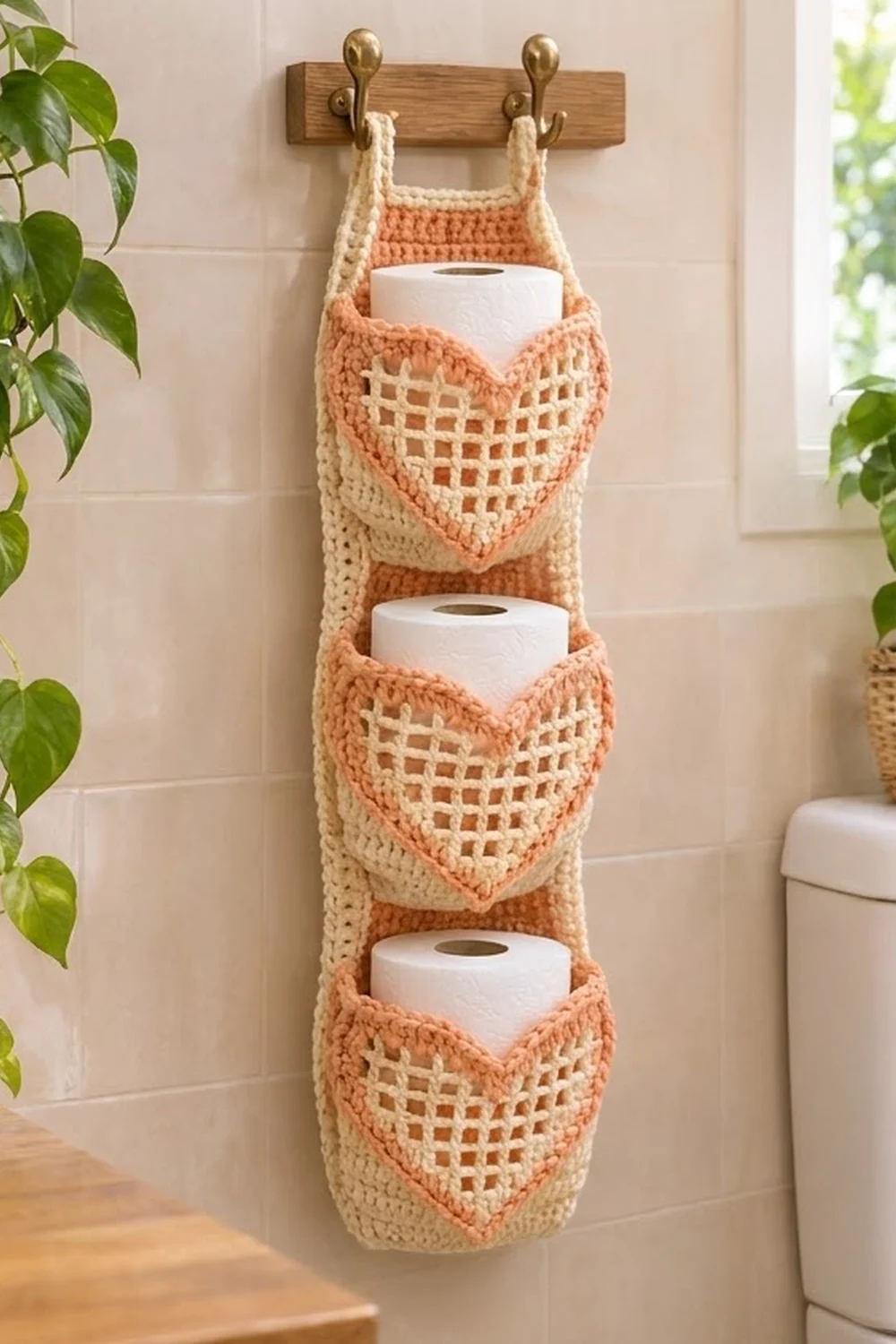
- Back panel: 1, in peach. The border and straps are cream.
- Pocket fronts: 3, in cream, with peach outline and trim.
- Gussets: 3, in cream.
Layout, viewed from the front:
Each pocket spans 22 panel rows, which is 5.5 in (14.0 cm). Pocket bottoms are spaced 36 rows apart, which is 9 in (22.9 cm).
Border
The border uses the same sc gauge as the panel, so its 2 rounds add 0.25 in (0.6 cm) per round on every edge.
Round 1: Use cream. With RS facing, join in the top-right corner st.
– Top edge: 3 sc in the corner st, 1 sc in each of the next 19 sts, 3 sc in the last st.
– Side edge: 1 sc in each row end of Rows 111–2. (110 sc)
– Bottom edge: 3 sc in the corner, 1 sc in each of the next 19 sts, 3 sc in the corner.
– Other side edge: 110 sc.
– Sl st to the first sc. (270 sc)
Counting each side from one corner center to the next, the top and bottom have 23 sts and the long sides have 114 sts. Check: 2 x 23 + 2 x 114 − 4 shared corners = 270.
Round 2: Ch 1, then work 1 sc in each st and 3 sc in each corner center st. Sl st to the first sc. (278 sc)
Each side gains 2 stitches. The top and bottom now have 25 sts each and the long sides have 116 sts. Check: 2 x 25 + 2 x 116 − 4 = 278.
Why the math works:
– Row 1 corners: the 3-sc corners use the first and last top stitches, so 19 + 2 corner groups = 25 sts across the top. The sides use only the 110 rows between the top and bottom rows, so no row is counted twice.
– Round 2: each corner adds 2 sts, giving +8 for the round.
– Size: the panel grows from 6 x 28 in (15.2 x 71.1 cm) to 7 x 29 in (17.8 x 73.7 cm).
Straps (Make 2)
- With RS facing, join cream in the first st of the 25-st top edge.
- Rows 1–24: Ch 1, sc in the first 5 sts, turn. (5 sc) Each strap is 6 in (15.2 cm) long.
- Fasten off, leaving a 10 in (25.4 cm) tail.
- Work the second strap the same way over top-edge sts 21–25. The 15 center sts stay free.
- Fold each strap to the back. Sew its last row to the WS of the border, directly behind the strap’s base. This makes a loop that hangs about 3 in (7.6 cm).
Joining
Step 1: Gusset to pocket front (slip-stitch seam).
1. Hold the gusset and the pocket front with RS together.
2. Match gusset Row 1 to the first edge-prep sc, and the marked rows to the bottom corners.
3. Working through one gusset row end and one prep stitch at a time, sl st across the full length. That’s 53 joins: 16 on the side, 21 on the bottom and 16 on the other side.
4. Turn the pocket RS out.
Step 2: Pocket to panel (whipstitch).
1. Pin the gusset’s free long edge to the panel.
2. Sew the bottom section (21 row ends) across the 21 sts of the marked panel row. Use one whipstitch per row end.
3. Sew each side section (16 row ends) up the panel’s edge column, stitch 1 or 21, across 16 panel rows. For Pocket 1, these are Rows 5–20.
Tension: Each gusset bottom section is 5.25 in (13.3 cm) when relaxed. It stretches 0.75 in (1.9 cm) to fit the 6 in (15.2 cm) front and back edges. That slight tension keeps the pocket floor firm. Pull each whipstitch snug but not tight, so the seam lies flat and doesn’t pucker.
Checkpoint: Each attached pocket should be 6.5 in (16.5 cm) across the lobes and stand about 2.9 in (7.4 cm) out from the panel. A standard roll, about 4.5 in (11.4 cm) wide and 4 in (10.2 cm) tall, should slide in with its top showing at the center dip.
Final Blocking
- Weave in all ends along same-color stitches.
- Mist the whole piece until it’s damp. Don’t soak it.
- Lay it face-up and pin the panel to 7 x 29 in (17.8 x 73.7 cm).
- Stuff each pocket with a roll or a rolled towel.
- Pull the mesh squares straight and pin the lobe tips into rounded shapes.
- Let it dry completely. Then hang it and check that both straps sit level.
Final Quality-Control Checklist
- The panel measures 7 x 29 in (17.8 x 73.7 cm).
- Border Round 2 has 278 sts with even corners.
- Each pocket front has 21 sts per row and 10 filet rows.
- The heart outline is continuous, with no gaps at the point.
- The trim has 48 sts per pocket.
- All 53 gusset joins are complete on each pocket.
- The pockets start at panel Rows 5, 41 and 77.
- The straps are equal length and securely sewn.
Troubleshooting
- Mesh squares look tall and narrow. Your dc is loose. Try a tighter yo or go down a hook size, and keep each ch 1 snug.
- The heart point is off-center. Recount Row 3: it should be 9 dc, two meshes, then 9 dc counting the turning ch.
- The gusset doesn’t reach the top of the front. Check that you worked 2 sc per dc row end in the edge prep row.
- A pocket sags under the roll. The bottom seam is too loose. Resew it with firmer whipstitches.
- The panel twists when hung. Block it again and check that both straps have exactly 24 rows.
- The border ruffles. You probably worked extra sc along the sides. Each side of Round 1 needs exactly 110.
Care
Hand wash or machine wash on a cool, gentle cycle in a laundry bag. Reshape while damp and dry flat. Don’t hang it to dry while wet.
Final Notes
The finished size depends on keeping each stage on measurement:
1. Gauge: 14 sts = 4 in (10.2 cm).
2. Pocket front: 21 sts = 6 in (15.2 cm).
3. Edge prep row: 53 sts, matched one-to-one to the 53 gusset rows.
4. Panel: 21 x 112 = 6 x 28 in (15.2 x 71.1 cm).
5. Border: 2 rounds bring the panel to 7 x 29 in (17.8 x 73.7 cm).
Check each number as you go and the three heart pockets will line up neatly.
Happy crocheting!
