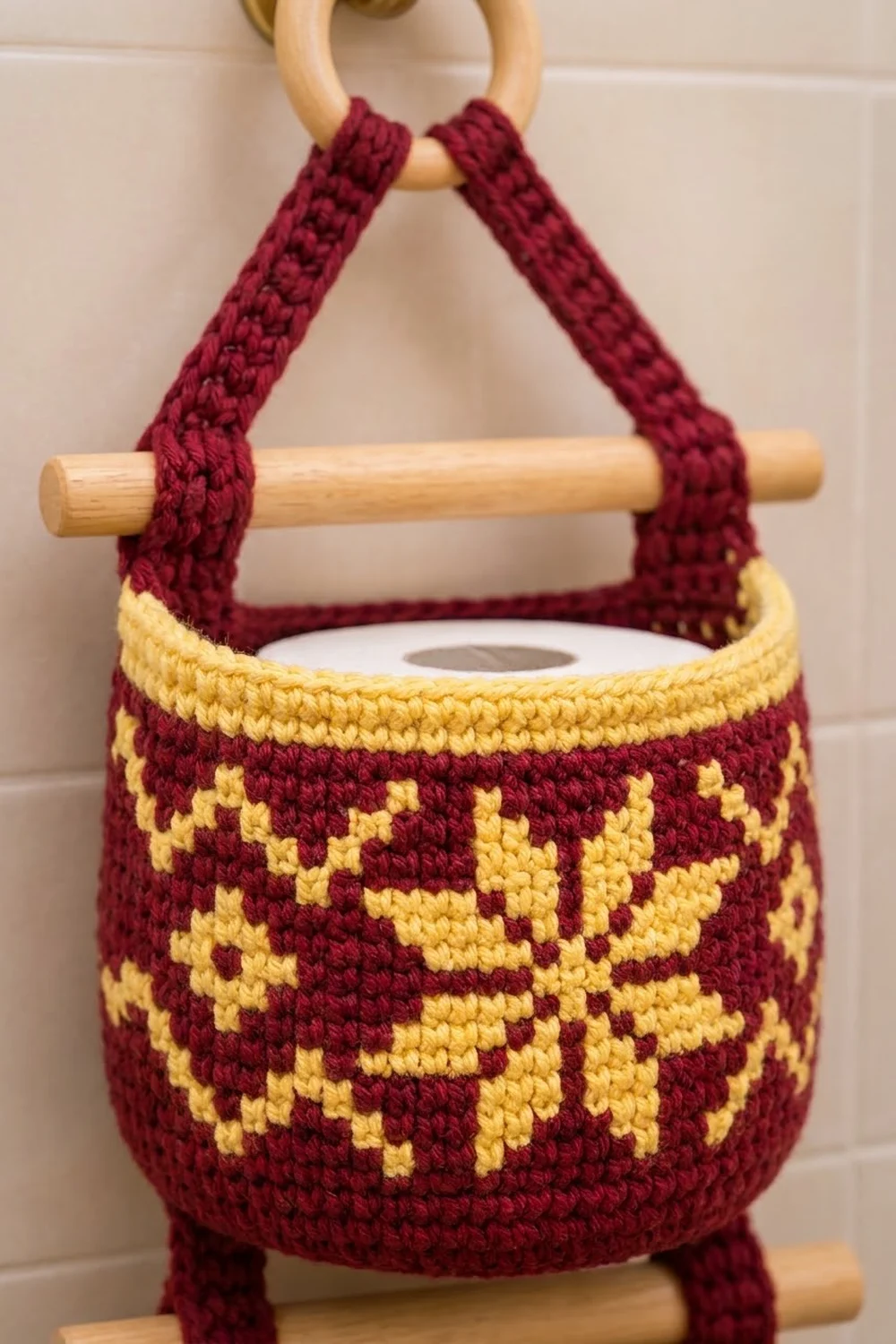
This hanging organizer holds three spare toilet rolls in a column of round crochet pockets. Each pocket has a yellow eight-point Nordic star on the front, a yellow diamond on each side of it and a yellow rolled rim. Two burgundy straps carry all three pockets, and wooden dowels hold the straps apart. A wooden ring at the top hangs on any hook.
The colors are a deep burgundy and a soft butter yellow, which gives the piece a cozy holiday look. The colorwork is tapestry crochet in single crochet. Both colors stay in play on the colorwork rounds, so the fabric is firm and the pockets hold their shape.
This pattern uses US crochet terms. Each pocket is about 4¾ in (12.1 cm) in diameter and 4¾ in (12.1 cm) tall. The assembled organizer hangs about 24 in (61.0 cm) long, including the ring.
Construction overview: Each pocket starts with a flat base worked in rounds. A back-loop round turns the base into a straight wall. Then come 13 colorwork rounds and a yellow rim border. The two straps are worked flat in rows, with slots for the dowels. Last, you sew the straps to the pockets and wrap them around the ring.
Finished Size and Construction
- Finished size: about 6 in (15.2 cm) wide at the dowels × 24 in (61.0 cm) long
- Skill level: Intermediate (tapestry color changes)
- Terminology: US
- Yarn weight: Worsted (#4) cotton or cotton blend
- Hook: 4.0 mm (US G-6)
- Number of pieces: 5 crochet pieces (3 pockets and 2 straps), plus 3 dowels and 1 ring
- Layout: 1 column of 3 pockets
- Pocket size: 4¾ in (12.1 cm) diameter × 4¾ in (12.1 cm) tall
- Wall height before border: 4 in (10.2 cm)
- Border depth: ¾ in (1.9 cm)
Materials
Yarn: Use a smooth worsted-weight cotton or cotton blend, about 85 m per 50 g. Cotton holds its shape and stands up to a humid bathroom. Avoid fuzzy yarns, because they blur the star.
- Color B (Burgundy): 200 g, about 340 m
- Color Y (Butter Yellow): 100 g, about 170 m
These quantities include a safety margin of about 15%.
Tools:
- 4.0 mm (US G-6) crochet hook
- Tapestry needle
- 6 stitch markers
- 1 wooden ring, 2½ in (6.4 cm) in diameter
- 3 wooden dowels, ⅜ in (1.0 cm) thick and 6 in (15.2 cm) long
- Scissors and a measuring tape
- Blocking pins and a spray bottle
Abbreviations (US Terms)
- ch: chain
- sc: single crochet
- inc: 2 sc in the same stitch
- BLO: back loop only
- sk: skip
- sl st: slip stitch
- sp: space
- MR: magic ring
- rev sc: reverse single crochet (crab stitch)
- st(s): stitch(es)
Tapestry sc: Lay the unused color on top of the stitches of the previous round and work over it with every sc, so it is carried inside the stitches. To change color, work the last sc of the old color until 2 loops remain on the hook. Yarn over with the new color and pull it through both loops.
Reading the colorwork rounds: “B14, Y1” means work 14 sc in B, then 1 sc in Y. Every round adds up to 60 sts.
Reverse sc: Working from left to right, insert the hook into the next stitch to the right, pull up a loop, yarn over and pull through both loops.
Gauge and Checkpoints
Gauge: 16 sts and 16 rounds = 4 in (10.2 cm) in tapestry sc, worked in the round. That is 4 sts and 4 rounds per 1 in (2.5 cm). The straps use the same gauge in rows.
Make one complete pocket before you start the others. That pocket is your gauge swatch.
Checkpoints:
- After Round 10: the base lies flat and measures 4¾ in (12.1 cm) across.
- After Round 26: the wall measures 4 in (10.2 cm) from the base fold, and the circumference is 15 in (38.1 cm).
- After Round 29: the wall measures 4¾ in (12.1 cm) from the base fold.
If the pocket is too big, go down 0.5 mm in hook size. If it is too small, or the fabric feels stiff, go up 0.5 mm. If the base ruffles, your rounds are shorter than your stitches are wide, so try a smaller hook for the base only. If the base cups, try a larger hook for the base only.
Pocket (Make 3)
Base
Work in continuous rounds with B. Place a marker in the first st of each round.
Rnd 1: MR, 6 sc in ring. (6 sts)
Rnd 2: inc in each st around. (12 sts)
Rnd 3: sc 1, inc 6 times. (18 sts)
Rnd 4: sc 2, inc 6 times. (24 sts)
Rnd 5: sc 3, inc 6 times. (30 sts)
Rnd 6: sc 4, inc 6 times. (36 sts)
Rnd 7: sc 5, inc 6 times. (42 sts)
Rnd 8: sc 6, inc 6 times. (48 sts)
Rnd 9: sc 7, inc 6 times. (54 sts)
Rnd 10: sc 8, inc 6 times. (60 sts)
Checkpoint: the base is 4¾ in (12.1 cm) across.
Wall
Rnd 11 (conversion round): With B, sc in BLO of each st. (60 sc worked 1 per existing st + 0 added = 60 sts.) This round creates the crisp fold between base and wall.
Rnd 12: With B, sc 60. At the start of this round, join Y and carry it inside the stitches. (60 sts)
In the next step, the stitch numbers count from the start of the round, which is the center back. The star is centered on st 31, the center front. The diamonds are centered on sts 18 and 44.
Rnd 13: B30, Y1, B29.
Rnd 14: B29, Y3, B28.
Rnd 15: B25, Y1, B3, Y3, B3, Y1, B24.
Rnd 16: B17, Y1, B7, Y2, B2, Y3, B2, Y2, B7, Y1, B16.
Rnd 17: B16, Y1, B1, Y1, B6, Y3, B1, Y3, B1, Y3, B6, Y1, B1, Y1, B15.
Rnd 18: B15, Y1, B3, Y1, B6, Y4, B1, Y4, B6, Y1, B3, Y1, B14.
Rnd 19: B14, Y1, B2, Y1, B2, Y1, B3, Y6, B1, Y6, B3, Y1, B2, Y1, B2, Y1, B13.
Rnd 20: Repeat Rnd 18.
Rnd 21: Repeat Rnd 17.
Rnd 22: Repeat Rnd 16.
Rnd 23: Repeat Rnd 15.
Rnd 24: Repeat Rnd 14.
Rnd 25: Repeat Rnd 13.
Every colorwork round totals 60 sts. Rounds 19 is the center row of the motif. It holds the star’s horizontal arms and the side points of both diamonds.
Rnd 26: With B, sc 60, still carrying Y. Cut B at the end of this round. (60 sts)
Checkpoint: the wall is 4 in (10.2 cm) tall (16 rounds).
